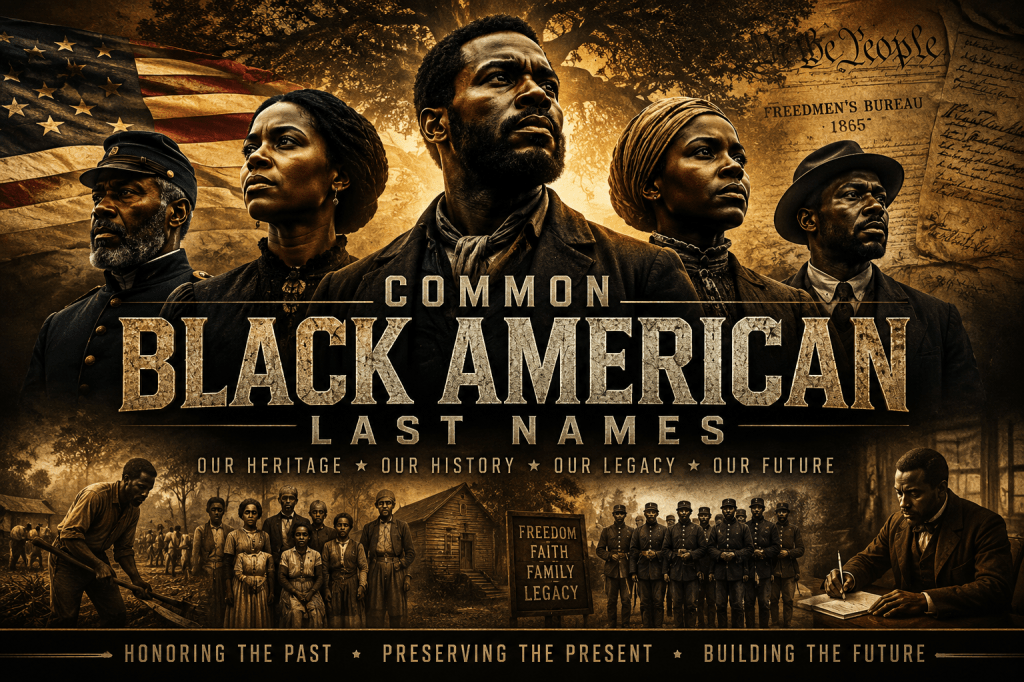
Common Black American Last Names
Preserving Our Family Names. Preserving Our History.
Black American surnames represent more than family names—they are living connections to generations of resilience, survival, achievement, and community.
Throughout American history, Black American families carried surnames through slavery, emancipation, Reconstruction, military service, migration, entrepreneurship, faith, and the building of communities across the United States. Some surnames were inherited from enslavers, while others were adopted after emancipation to establish new family identities or honor respected individuals.
Today, these names appear throughout every profession, every branch of military service, every level of government, education, business, science, athletics, and the arts.
This archive was created to help preserve and document the surnames that have become part of the historical fabric of Black American communities.
Why This Page Exists
The Black American International Union (BAIU) believes that preserving family history is an important part of preserving a people’s story.
Our goals include:
- Preserving historically documented Black American family surnames.
- Encouraging genealogy and family history research.
- Connecting individuals with historical records.
- Helping future generations better understand their family origins.
- Protecting the historical legacy of Black American families.
A Historical Reminder
A surname by itself does not establish Black American ancestry, ethnicity, tribal affiliation, or family lineage.
Many surnames are shared by people from many different racial, ethnic, and national backgrounds.
Family history is best documented through historical records such as:
- United States Census records
- Birth certificates
- Death certificates
- Marriage records
- Freedmen’s Bureau records
- Freedman’s Bank records
- Military service records
- Church records
- Cemetery records
- Probate records
- Land records
- Family Bibles
- Oral histories
- Historical newspapers
- State archives
- National Archives records
Common Black American Surnames
The following surnames have been commonly found throughout historic and modern Black American communities across the United States.
Adams • Allen • Anderson • Bailey • Baker • Banks • Bell • Bennett • Black • Boone • Boyd • Bradley • Brooks • Brown • Bryant • Butler • Campbell • Carter • Clark • Coleman • Collins • Cook • Cooper • Crawford • Daniels • Davis • Dixon • Douglas • Edwards • Ellis • Evans • Fields • Fisher • Ford • Foster • Franklin • Freeman • Gaines • Gardner • Gibson • Gordon • Graham • Grant • Gray • Green • Griffin • Hall • Hamilton • Harris • Harrison • Hawkins • Hayes • Henderson • Henry • Hill • Holmes • Howard • Hughes • Hunter • Jackson • James • Jefferson • Jenkins • Johnson • Jones • Jordan • Kelly • King • Knight • Lee • Lewis • Marshall • Martin • Mason • Matthews • McCoy • McDaniel • McKinney • Miller • Mitchell • Montgomery • Moore • Morgan • Morris • Murphy • Nelson • Owens • Parker • Patterson • Perry • Phillips • Porter • Powell • Price • Reed • Richardson • Roberts • Robinson • Ross • Sanders • Scott • Shaw • Simmons • Smith • Spencer • Stewart • Taylor • Thomas • Thompson • Tucker • Turner • Walker • Wallace • Ward • Washington • Watson • White • Williams • Wilson • Woods • Wright • Young
Featured Historical Surnames
The following surnames appear repeatedly throughout American history in connection with Black American families, military service, education, business, civil rights, politics, religion, and community leadership:
- Brown
- Carter
- Davis
- Freeman
- Jackson
- Jefferson
- Johnson
- Jones
- King
- Lee
- Lewis
- Marshall
- Robinson
- Scott
- Thomas
- Walker
- Washington
- Williams
This Archive Is Growing
This page is only the beginning.
BAIU is actively expanding this historical archive to include:
- Historically documented pre-1865 Black American family surnames
- Freedmen’s Bureau family records
- Freedman’s Bank family records
- United States Colored Troops (USCT) family names
- Revolutionary War and War of 1812 Black American families
- Black Seminole family surnames
- Gullah Geechee family surnames
- Cherokee, Choctaw, Chickasaw, Creek, and Seminole Freedmen family records
- Reconstruction-era community leaders
- Historic Black churches and cemetery records
- Genealogical resources for family research
Our mission is to preserve the names, stories, and historical records of the families who helped shape the United States so that future generations can continue to research, remember, and honor their ancestors.
Historic Black American Surnames Documented Before 1865
Preserving the Earliest Recorded Black American Families
Long before the Civil War ended in 1865, Black Americans had already established families, communities, churches, businesses, farms, military service, and institutions throughout what is now the United States.
Many families can be documented in historical records dating back to the 1600s, 1700s, and early 1800s through census records, tax rolls, church registers, court proceedings, military records, newspapers, wills, probate files, land deeds, and other historical documents.
These records provide valuable insight into the lives of free Black Americans, enslaved individuals, skilled tradesmen, soldiers, ministers, educators, property owners, entrepreneurs, and community leaders whose descendants continue to contribute to the nation today.
Why Pre-1865 Records Matter
Historical records created before December 1865 provide important evidence that many Black American families were already established in the United States before the abolition of slavery.
These records may help researchers trace family history through:
- Colonial America
- The Revolutionary War
- The War of 1812
- The Antebellum Period
- Free Black communities
- Early Black churches
- Property ownership
- Military service
- Court records
- Tax records
- Local government archives
No single record proves an individual’s ancestry, but together these historical sources can help families reconstruct their lineage across multiple generations.
Examples of Historically Documented Surnames
The following surnames have been documented in historical records before 1865 among Black Americans in various regions of the United States. Their appearance in these records does not mean every person with that surname shares the same ancestry.
- Ash
- Blue
- Bowser
- Brown
- Carter
- Cumbo
- Cuffee
- Drayton
- Fields
- Goins
- Green
- Granger
- Harmond
- Hazzard
- Key
- Langston
- Leak
- Mazique
- Pinder
- Queen
- Russwurm
- Smalls
- Tanner
- Thomas
- Truth
- Tubman
- Vesey
- Walker
- Ward
- Washington
- Yancey
Historical Records Used in Genealogical Research
Researchers often consult records such as:
- Colonial census records
- State census records
- Church baptism and marriage registers
- Plantation records
- Probate and estate records
- Wills
- Deeds and land grants
- Tax assessment rolls
- Court records
- County archives
- Military pension files
- Revolutionary War service records
- War of 1812 service records
- Free Black registers
- Historical newspapers
- Cemetery records
- Family Bibles
- Oral histories
Continuing the Record
Many early Black American families left behind remarkable histories that remain preserved in archives across the United States.
BAIU encourages individuals and families to preserve photographs, family Bibles, military documents, letters, oral histories, and other records that can help future generations better understand their ancestry and the history of Black American communities.
This page will continue to expand as additional historical records are researched and documented.
Common Surnames Found Throughout Freedmen’s Bureau Records
Freedmen’s Bureau records document millions of Black Americans by name between 1865 and 1872. While no surname is unique to Black Americans, many family names appear repeatedly throughout these historical records across the Southern United States.
Examples include:
Adams • Allen • Anderson • Bailey • Baker • Banks • Bell • Bennett • Black • Boone • Boyd • Bradley • Brooks • Brown • Bryant • Butler • Campbell • Carter • Clark • Coleman • Collins • Cook • Cooper • Crawford • Daniels • Davis • Dixon • Douglas • Edwards • Ellis • Evans • Fields • Fisher • Ford • Foster • Franklin • Freeman • Gaines • Gardner • Gibson • Gordon • Graham • Grant • Gray • Green • Griffin • Hall • Hamilton • Harris • Harrison • Hawkins • Hayes • Henderson • Henry • Hill • Holmes • Howard • Hughes • Hunter • Jackson • James • Jefferson • Jenkins • Johnson • Jones • Jordan • Kelly • King • Knight • Lee • Lewis • Marshall • Martin • Mason • Matthews • McCoy • McDaniel • McKinney • Miller • Mitchell • Montgomery • Moore • Morgan • Morris • Murphy • Nelson • Owens • Parker • Patterson • Perry • Phillips • Porter • Powell • Price • Reed • Richardson • Roberts • Robinson • Ross • Sanders • Scott • Shaw • Simmons • Smith • Spencer • Stewart • Taylor • Thomas • Thompson • Tucker • Turner • Walker • Wallace • Ward • Washington • Watson • White • Williams • Wilson • Woods • Wright • Young
These surnames appear throughout Bureau records in labor contracts, marriage certificates, school records, court proceedings, hospital records, military-related documents, family reunification records, and other Reconstruction-era records. A surname’s appearance in these records does not, by itself, establish a person’s ancestry or lineage, but these documents can provide valuable starting points for genealogical research when combined with other historical sources.
Freedman’s Bank Records (1865–1874)
One of the Richest Sources for Black American Family History
The Freedman’s Savings and Trust Company, commonly known as the Freedman’s Bank, was established by Congress in 1865 to encourage financial stability among formerly enslaved people, free Black Americans, and Black Union soldiers following the Civil War.
Although the bank ultimately failed in 1874, the account registration records it left behind remain one of the most valuable genealogical resources for researching Black American ancestry.
Today, these records help millions of descendants reconnect with their family history.
What Information Can Be Found?
Unlike many historical records, Freedman’s Bank applications often recorded extensive family information, including:
- Full name
- Age
- Date of birth (when known)
- Place of birth
- Current residence
- Occupation
- Employer
- Parents’ names
- Mother’s maiden name (sometimes)
- Spouse’s name
- Children’s names
- Brothers and sisters
- Grandparents (occasionally)
- Military service
- United States Colored Troops (USCT) service
- Signature or mark of the depositor
These details can help connect multiple generations of a family.
Common Surnames Found in Freedman’s Bank Records
The bank’s records include hundreds of thousands of account holders and reference many Black American families. Frequently encountered surnames include:
Adams • Allen • Anderson • Bailey • Baker • Banks • Bell • Bennett • Black • Boone • Boyd • Brooks • Brown • Bryant • Butler • Campbell • Carter • Clark • Coleman • Collins • Cook • Cooper • Crawford • Daniels • Davis • Edwards • Ellis • Evans • Fields • Foster • Franklin • Freeman • Gaines • Gibson • Gordon • Grant • Gray • Green • Hall • Hamilton • Harris • Hawkins • Hayes • Henderson • Henry • Hill • Holmes • Howard • Hughes • Hunter • Jackson • James • Jefferson • Jenkins • Johnson • Jones • King • Lee • Lewis • Marshall • Martin • Mason • Miller • Mitchell • Montgomery • Moore • Morgan • Morris • Nelson • Owens • Parker • Perry • Porter • Powell • Price • Reed • Richardson • Roberts • Robinson • Ross • Sanders • Scott • Simmons • Smith • Stewart • Taylor • Thomas • Thompson • Turner • Walker • Wallace • Ward • Washington • Watson • White • Williams • Wilson • Wright • Young
These surnames appear throughout the bank’s records, but a surname alone does not establish ancestry. Genealogical conclusions should be based on multiple historical records.
Why These Records Matter
Freedman’s Bank applications often reveal family relationships that are not recorded anywhere else.
Researchers have used these records to:
- Identify parents and grandparents.
- Locate siblings and extended relatives.
- Trace family migration after emancipation.
- Connect military service to later civilian life.
- Confirm birthplaces and occupations.
- Reconstruct family trees across several generations.
For many families, these records provide the first detailed snapshot of relatives living after emancipation.
Cities with Freedman’s Bank Branches
Accounts were opened at branches in several cities, including:
- Atlanta, Georgia
- Baltimore, Maryland
- Charleston, South Carolina
- Louisville, Kentucky
- Memphis, Tennessee
- Mobile, Alabama
- Nashville, Tennessee
- New Orleans, Louisiana
- Norfolk, Virginia
- Richmond, Virginia
- Savannah, Georgia
- Vicksburg, Mississippi
- Washington, D.C., and others
People often traveled between cities, so researchers should consider searching multiple branch locations.
Research Tips
When searching Freedman’s Bank records:
- Search for spelling variations of surnames.
- Look for relatives listed on the same or nearby applications.
- Compare the information with the 1870 and 1880 U.S. Census.
- Search using both first names and surnames.
- Review military and pension records alongside bank records.
- Save copies of every document and record the archive citation.
One account registration can unlock generations of family history.
Preserving Our Legacy
The Freedman’s Bank records preserve more than financial transactions—they preserve names, families, relationships, occupations, and communities during one of the most significant periods in American history.
By studying these records alongside other historical sources, descendants can continue uncovering the stories of Black American families and ensure those histories are preserved for future generations.
United States Colored Troops (USCT)
Black American Military Families (1863–1865)
When President Abraham Lincoln authorized the enlistment of Black soldiers during the Civil War, thousands of Black American men answered the call to serve in the Union Army.
These soldiers became known as the United States Colored Troops (USCT).
Between 1863 and 1865, nearly 180,000 Black soldiers and approximately 20,000 Black sailors served the Union, participating in hundreds of battles and military operations that contributed to preserving the United States and ending slavery.
Today, USCT military records remain among the most valuable historical resources for tracing Black American family history.
Information Found in USCT Records
Military service records may contain:
- Full name
- Age
- Birthplace
- Residence
- Occupation
- Physical description
- Military unit
- Rank
- Company
- Regiment
- Date of enlistment
- Date of discharge
- Pension records
- Widow pension applications
- Children’s information
- Death records
- Burial information
Many pension files also include affidavits from family members, neighbors, ministers, and fellow soldiers, providing valuable genealogical information.
Common Surnames Found in USCT Records
Thousands of Black American families are represented in United States Colored Troops records. Frequently encountered surnames include:
Adams • Allen • Anderson • Bailey • Baker • Banks • Bell • Bennett • Brooks • Brown • Bryant • Butler • Campbell • Carter • Clark • Coleman • Collins • Cook • Cooper • Crawford • Davis • Edwards • Ellis • Evans • Fields • Foster • Franklin • Freeman • Gaines • Gibson • Gordon • Grant • Gray • Green • Hall • Hamilton • Harris • Hawkins • Hayes • Henderson • Henry • Hill • Holmes • Howard • Hughes • Hunter • Jackson • James • Jefferson • Jenkins • Johnson • Jones • King • Lee • Lewis • Marshall • Martin • Mason • Miller • Mitchell • Montgomery • Moore • Morgan • Morris • Nelson • Owens • Parker • Perry • Porter • Powell • Price • Reed • Richardson • Roberts • Robinson • Ross • Sanders • Scott • Simmons • Smith • Stewart • Taylor • Thomas • Thompson • Turner • Walker • Wallace • Ward • Washington • Watson • White • Williams • Wilson • Wright • Young
These surnames appear throughout USCT records, but a surname alone does not establish ancestry. Researchers should compare military records with census records, pension files, church records, and other historical sources.
Black American Military Service
USCT soldiers served in:
- Infantry Regiments
- Cavalry Regiments
- Heavy Artillery
- Light Artillery
- Engineers
- Supply Units
- Naval Service
Many received military honors for bravery under extremely difficult conditions.
Why These Records Matter
USCT records often bridge the gap between slavery and freedom.
Researchers may discover:
- Parents
- Spouses
- Children
- Siblings
- Places of birth
- Former residences
- Military pensions
- Burial locations
- Community connections
- Migration patterns after the Civil War
For many families, these military records provide the first official government documentation identifying an ancestor by name.
Continuing the Legacy
The service of the United States Colored Troops represents courage, sacrifice, and commitment during one of the defining periods in American history.
Their military records preserve the names and stories of thousands of Black American families whose contributions helped shape the nation’s future.
BAIU encourages descendants to preserve military photographs, discharge papers, pension files, medals, family letters, and oral histories so that future generations can continue honoring the legacy of those who served.
Black Patriots of the American Revolutionary War (1775–1783)
Black Americans in the Fight for Independence
During the American Revolutionary War (1775–1783), thousands of people of African descent—both free and enslaved—participated in the conflict. They served in the Continental Army, state militias, and the Continental Navy, while others served with the British after being promised freedom.
For many families, Revolutionary War records represent some of the earliest surviving military documentation connected to Black Americans in what became the United States.
These records provide valuable information for historical and genealogical research.
Information Found in Revolutionary War Records
Depending on the record, researchers may find:
- Full name
- Military unit
- Rank
- State of service
- Dates of enlistment
- Pension applications
- Residence
- Age
- Occupation
- Family members
- Witness statements
- Land grant information
- Burial locations
Some pension applications also contain personal narratives describing wartime service and later life.
Historically Documented Black Patriots
Among the best-known Black participants in the Revolutionary War are:
- Crispus Attucks
- Peter Salem
- Salem Poor
- Prince Estabrook
- Lemuel Haynes
- James Armistead Lafayette
- Agrippa Hull
- Oliver Cromwell
- Primus Hall
- Cato Howe
These individuals are documented in historical military and government records and represent only a small portion of the Black men who participated in the Revolutionary War.
Common Surnames Found in Revolutionary War Records
Researchers studying Revolutionary War-era Black families may encounter surnames such as:
Adams • Allen • Brown • Carter • Clark • Cooper • Davis • Freeman • Green • Hall • Harris • Jackson • Johnson • Jones • King • Lee • Lewis • Martin • Moore • Parker • Perry • Reed • Robinson • Scott • Smith • Taylor • Thomas • Walker • Ward • Washington • White • Williams • Wilson
These surnames appear in various Revolutionary War-era records, but a surname by itself does not establish ancestry. Genealogical conclusions should be based on multiple historical sources.
Why These Records Matter
Revolutionary War records can help researchers:
- Identify early Black military service.
- Locate ancestors in colonial America.
- Connect families across generations.
- Trace migration after the war.
- Find pension and land records.
- Better understand family and community history.
When combined with census records, church records, probate files, and local archives, these documents can provide a more complete picture of a family’s past.
Preserving an Overlooked Legacy
The stories preserved in Revolutionary War records remind us that people of African descent were part of the nation’s earliest history and contributed to the struggle for independence in many different ways.
By preserving these records and continuing genealogical research, future generations can better understand the diverse experiences of the families who lived through the Revolutionary era and helped shape the United States.
Free Black Communities Before the Civil War
Building Families, Communities, and Institutions Before 1865
Long before the Civil War ended, thousands of free Black Americans had already established families and communities throughout the United States.
Some gained freedom through military service, emancipation by enslavers, birth into free families, self-purchase, or state laws recognizing free status. Despite facing discriminatory laws and significant restrictions, many built churches, schools, farms, businesses, mutual aid societies, and neighborhoods that became the foundation of later Black American communities.
Their names and lives are preserved in historical records that continue to help descendants trace their family history.
Historical Records That Document These Communities
Researchers may find ancestors in:
- Federal Census records
- State Census records
- Tax rolls
- Property deeds
- Land grants
- Probate records
- Wills
- Church membership records
- Marriage records
- Birth records
- Death records
- Apprenticeship records
- Court proceedings
- Newspaper archives
- Voter registration records (where applicable)
- Military records
- Cemetery records
Together, these sources help reconstruct family histories across generations.
Examples of Historic Free Black Communities
Documented free Black communities existed in many parts of the United States, including:
- Philadelphia, Pennsylvania
- Baltimore, Maryland
- Boston, Massachusetts
- New York City, New York
- Cincinnati, Ohio
- Charleston, South Carolina
- New Orleans, Louisiana
- Richmond, Virginia
- Petersburg, Virginia
- Washington, D.C.
Many smaller rural settlements and farming communities also developed throughout the South and border states.
Common Surnames Found in Historical Records
Researchers studying free Black communities may encounter surnames such as:
Adams • Allen • Ash • Bailey • Banks • Bell • Blue • Brown • Carter • Clark • Coleman • Cooper • Cumbo • Cuffee • Davis • Drayton • Fields • Freeman • Goins • Gordon • Granger • Green • Hall • Harris • Hawkins • Hazzard • Henderson • Jackson • James • Jefferson • Jenkins • Johnson • Jones • Key • Langston • Leak • Lee • Lewis • Martin • Mazique • Moore • Nelson • Pinder • Queen • Reed • Richardson • Robinson • Russwurm • Scott • Simmons • Smith • Tanner • Thomas • Walker • Ward • Washington • White • Williams • Wilson • Yancey
These surnames appear in various historical records associated with free Black communities. A shared surname alone does not establish family relationships or ancestry and should be evaluated alongside additional genealogical evidence.
Building Independent Institutions
Free Black communities established and supported institutions that strengthened family and community life, including:
- Churches
- Schools
- Mutual aid societies
- Fraternal organizations
- Newspapers
- Businesses
- Farms
- Skilled trades
- Maritime industries
- Educational organizations
These institutions provided opportunities for leadership, education, economic activity, and community support despite widespread legal and social barriers.
Why These Records Matter
Records from free Black communities can help descendants:
- Trace ancestors before the Civil War.
- Identify family relationships.
- Locate land ownership and occupations.
- Discover church memberships.
- Find military service.
- Connect census records across generations.
- Understand migration patterns.
- Preserve family history for future generations.
Every historical document contributes another piece to the story of Black American families and the communities they helped build.
Preserving Our History
The history of free Black communities is an essential part of American history.
By preserving historical documents, photographs, family Bibles, oral histories, cemetery records, and local archives, we help ensure that future generations can continue researching, understanding, and honoring the lives of the families who came before them.
Every name preserved is another chapter in the continuing story of Black American history.
Gullah Geechee Families & Historic Surnames
Preserving the Legacy of the Gullah Geechee People
The Gullah Geechee people are descendants of Black communities that developed along the coastal regions and Sea Islands of South Carolina, Georgia, northern Florida, and North Carolina. Through generations, they preserved distinctive traditions in language, foodways, music, craftsmanship, storytelling, agriculture, and community life.
Today, historical records from Gullah Geechee communities provide an important resource for genealogical research and help preserve the history of many Black American families.
Common Surnames Documented in Gullah Geechee Communities
Historical records from Gullah Geechee communities include families with surnames such as:
Alston
Bailey
Bennett
Brown
Bryan
Capers
Chisholm
Cummings
Drayton
Fields
Fripp
Gadsden
Green
Hamilton
Heyward
Huger
Jenkins
Ladson
Manigault
Martin
Middleton
Mikell
Murray
Pinckney
Prioleau
Ravenel
Rivers
Scott
Seabrook
Simmons
Singleton
Smalls
Stanyarne
Washington
Whaley
White
Williams
These surnames appear in historical records associated with Gullah Geechee communities. Their presence in these records does not mean that every person with the surname is Gullah Geechee or shares the same ancestry.
Historical Records That Preserve These Families
Researchers may find Gullah Geechee ancestors in:
- Federal Census records
- Plantation records
- Freedmen’s Bureau records
- Freedman’s Bank records
- Church registers
- Marriage records
- Birth records
- Death records
- Cemetery records
- Property deeds
- Probate records
- Military service records
- Newspaper archives
- Local county archives
Family Names Across the Sea Islands
Historically documented family names appear throughout communities in:
- Beaufort County, South Carolina
- Charleston County, South Carolina
- Georgetown County, South Carolina
- Jasper County, South Carolina
- McIntosh County, Georgia
- Glynn County, Georgia
- Liberty County, Georgia
- Camden County, Georgia
- Sapelo Island
- St. Helena Island
- Hilton Head Island
- Edisto Island
- Johns Island
Many of these surnames have remained in the same communities for generations.
Why These Records Matter
Gullah Geechee historical records help researchers:
- Trace family lineages.
- Identify ancestral communities.
- Connect families through multiple generations.
- Locate churches and cemeteries.
- Study migration patterns.
- Preserve oral histories.
- Better understand regional Black American history.
Preserving the Gullah Geechee Legacy
The history of the Gullah Geechee people is an important part of the broader story of Black Americans.
By preserving family names, historical documents, oral traditions, photographs, cemeteries, and community records, future generations can continue researching and honoring the families whose lives shaped the Sea Islands and the coastal South.
Black Seminole Families & Historic Surnames
Preserving the Legacy of Black Seminole Families
Black Seminoles are descendants of people of African descent who became part of Seminole communities in Florida and later, through forced removal and migration, in Indian Territory (present-day Oklahoma), Texas, northern Mexico, and other regions.
Throughout the 1700s and 1800s, Black Seminole families served as interpreters, scouts, soldiers, farmers, ranchers, craftspeople, and community leaders. Their lives are documented in military records, tribal records, census records, treaty records, church registers, and other historical sources.
Today, these records remain an important resource for descendants researching their family history.
Historically Documented Black Seminole Surnames
Researchers studying Black Seminole history may encounter families with surnames such as:
Bruner
Caesar
Daniels
Factor
July
Marshall
McIntosh
Payne
Perryman
Brinson
Gopher
Fields
Walker
Grayson
Johnson
Williams
Thomas
Washington
Smith
Jones
Brown
Jackson
Scott
Mitchell
Green
King
Lee
Carter
Robinson
Davis
Moore
These surnames have appeared in historical records associated with Black Seminole communities. However, a surname alone does not establish Black Seminole ancestry. Family lineage should be researched using multiple historical sources.
Historical Records That Preserve Black Seminole Families
Researchers may find Black Seminole ancestors in:
- Seminole tribal records
- Treaty records
- Military records
- Indian Territory census records
- Dawes Commission records
- Freedmen Rolls
- Bureau of Indian Affairs records
- National Archives records
- Church registers
- Marriage records
- Land allotment records
- Pension files
- Cemetery records
- County archives
- Historical newspapers
These records often identify family relationships, residences, occupations, military service, and migration patterns.
Historic Black Seminole Communities
Historically documented Black Seminole families lived in areas including:
- Spanish Florida
- Florida Territory
- Indian Territory (present-day Oklahoma)
- Texas
- Coahuila, Mexico
- Northern Mexico border settlements
Many families relocated multiple times due to war, forced removal, and changing political conditions.
Why These Records Matter
Black Seminole records can help descendants:
- Trace family lineages.
- Connect relatives across generations.
- Locate military service records.
- Identify treaty and tribal records.
- Discover migration routes.
- Preserve oral histories.
- Better understand the history of Black Seminole communities.
Every historical document contributes another piece to the story of these families.
Preserving the Legacy
The history of Black Seminole families is an important part of both Black American history and Seminole history.
By preserving names, historical records, photographs, family Bibles, oral traditions, military documents, and cemetery records, descendants can help ensure that future generations continue to learn from and honor the lives of those who came before them.
Every preserved name strengthens the historical record and contributes to a deeper understanding of America’s diverse past.
Cherokee Freedmen Families & Historic Surnames
Preserving the Legacy of Cherokee Freedmen Families
Cherokee Freedmen are descendants of formerly enslaved people held by citizens of the Cherokee Nation and of free Black people who became part of Cherokee communities before and after the Civil War.
Following the Treaty of 1866, many Cherokee Freedmen were recognized within the Cherokee Nation, and their families were documented in tribal censuses, citizenship rolls, land allotment records, court proceedings, and other official records.
Today, these records are among the most valuable resources for descendants researching Cherokee Freedmen ancestry.
Historically Documented Cherokee Freedmen Surnames
Researchers studying Cherokee Freedmen history may encounter families with surnames such as:
Adair
Benge
Bell
Brown
Bushyhead
Carter
Christie
Cochran
Conley
Downing
Fields
Foreman
Glass
Grayson
Guess
Hicks
Johnson
Jones
Lewis
McCoy
McIntosh
Miller
Moore
Ross
Sanders
Scraper
Smith
Stapler
Starr
Taylor
Thomas
Vann
Walker
Washington
Williams
Wilson
These surnames appear in historical records associated with Cherokee Freedmen families. A shared surname alone does not establish Cherokee Freedmen ancestry or Cherokee Nation citizenship. Genealogical conclusions should be based on multiple historical records.
Historical Records That Preserve Cherokee Freedmen Families
Researchers may find Cherokee Freedmen ancestors in:
- Treaty of 1866 records
- Cherokee Nation Census records
- Cherokee Freedmen Rolls
- Dawes Commission enrollment records
- Dawes Packets
- Allotment records
- Bureau of Indian Affairs records
- National Archives records
- Marriage records
- Church registers
- Cemetery records
- Probate records
- Military service records
- Historical newspapers
- Oklahoma county records
These records may identify family relationships, ages, residences, occupations, tribal affiliations, and land allotments.
Historic Cherokee Freedmen Communities
Cherokee Freedmen families lived throughout the Cherokee Nation in present-day Oklahoma and earlier Cherokee homelands. Many communities later developed around:
- Tahlequah
- Muskogee
- Fort Gibson
- Vinita
- Pryor
- Nowata
- Claremore
- Wagoner
- Sequoyah County
- Cherokee County
Many families remained in these communities for generations, while others migrated to Arkansas, Texas, Kansas, Missouri, and elsewhere.
Why These Records Matter
Cherokee Freedmen records can help descendants:
- Trace family lineages.
- Identify parents and grandparents.
- Connect relatives across generations.
- Locate land allotments.
- Discover military service.
- Understand migration patterns.
- Preserve family stories and oral histories.
Each historical document adds another piece to a family’s history.
Preserving the Legacy
The history of Cherokee Freedmen families is an important part of both Black American history and Cherokee Nation history.
By preserving historical documents, photographs, cemetery records, church registers, family Bibles, and oral histories, descendants help ensure that future generations can continue researching, understanding, and honoring the lives of those who came before them.
Every documented name contributes to preserving an important chapter of American history.
Choctaw Freedmen Families & Historic Surnames
Preserving the Legacy of Choctaw Freedmen Families
Choctaw Freedmen are descendants of formerly enslaved people held by citizens of the Choctaw Nation and others who became part of Choctaw communities before and after the Civil War.
Following the Civil War and the Treaty of 1866, many Choctaw Freedmen families were documented in tribal records, census rolls, land records, court proceedings, and other historical documents that remain valuable resources for genealogical research.
These records help preserve the names and histories of families who contributed to the growth and development of the Choctaw Nation and the United States.
Historically Documented Choctaw Freedmen Surnames
Researchers studying Choctaw Freedmen history may encounter families with surnames such as:
Alexander
Allen
Anderson
Brown
Bryant
Butler
Carter
Colbert
Davis
Durant
Edwards
Fields
Folsom
Gardner
Green
Hall
Harris
Jackson
James
Johnson
Jones
King
Lewis
Locke
Martin
McCurtain
McKinney
Moore
Nelson
Perry
Reed
Roberts
Robinson
Scott
Smith
Taylor
Thomas
Thompson
Walker
Ward
Washington
Williams
Wilson
Wright
These surnames appear in historical records associated with Choctaw Freedmen families. A surname alone does not establish Choctaw Freedmen ancestry, Choctaw Nation citizenship, or a specific family relationship. Genealogical conclusions should be supported by multiple historical records.
Historical Records That Preserve Choctaw Freedmen Families
Researchers may find Choctaw Freedmen ancestors in:
- Treaty of 1866 records
- Choctaw Nation Census records
- Choctaw Freedmen Rolls
- Dawes Commission enrollment records
- Dawes Enrollment Packets
- Land allotment records
- Bureau of Indian Affairs records
- National Archives records
- Marriage records
- Church registers
- Cemetery records
- Probate and estate records
- Military service records
- Historical newspapers
- Oklahoma county records
These records often identify family members, residences, occupations, ages, land allotments, and community connections.
Historic Choctaw Freedmen Communities
Historically documented Choctaw Freedmen families lived throughout the Choctaw Nation in present-day southeastern Oklahoma, including communities near:
- Durant
- Hugo
- Antlers
- Atoka
- Tuskahoma
- Broken Bow
- Idabel
- McAlester
- Wilburton
Many descendants later migrated to Arkansas, Texas, Louisiana, Missouri, and other parts of the United States.
Why These Records Matter
Choctaw Freedmen records can help descendants:
- Trace family lineages.
- Identify parents, grandparents, and siblings.
- Locate land allotments.
- Discover military service.
- Connect multiple generations.
- Understand migration patterns.
- Preserve family history for future generations.
Each record contributes to a broader understanding of both family history and the history of the Choctaw Nation.
Preserving the Legacy
The history of Choctaw Freedmen families is an important part of American history and the history of the Choctaw Nation.
By preserving historical documents, family photographs, cemetery records, church registers, military papers, family Bibles, and oral histories, descendants help ensure that these stories continue to be remembered and researched.
Every documented name strengthens the historical record and helps preserve the legacy of the families who came before us.
Muscogee (Creek) Freedmen Families & Historic Surnames
Preserving the Legacy of Muscogee (Creek) Freedmen Families
Muscogee (Creek) Freedmen are descendants of formerly enslaved people held by citizens of the Muscogee (Creek) Nation and others who became part of Creek communities before and after the Civil War.
Following the Treaty of 1866, many Creek Freedmen families were documented in tribal censuses, citizenship records, Dawes Commission records, land allotment files, church registers, military records, and other historical documents.
Today, these records provide an important resource for descendants researching their family history and preserving the stories of Creek Freedmen communities.
Historically Documented Muscogee (Creek) Freedmen Surnames
Researchers studying Muscogee (Creek) Freedmen history may encounter families with surnames such as:
Alexander
Anderson
Barnett
Bell
Bruner
Brown
Carter
Cloud
Coleman
Davis
Fields
Foreman
Foster
Grayson
Hall
Harjo
Harris
Hicks
Jackson
James
Johnson
Jones
King
Lewis
Marshall
McIntosh
Miller
Moore
Perryman
Porter
Reed
Robinson
Ross
Scott
Smith
Stidham
Taylor
Thomas
Tiger
Walker
Ward
Washington
Williams
Wilson
These surnames appear in historical records associated with Muscogee (Creek) Freedmen families. A surname alone does not establish Creek Freedmen ancestry, Muscogee Nation citizenship, or a specific family relationship. Genealogical conclusions should be supported by multiple historical records.
Historical Records That Preserve Muscogee (Creek) Freedmen Families
Researchers may find Muscogee (Creek) Freedmen ancestors in:
- Treaty of 1866 records
- Muscogee (Creek) Nation census records
- Creek Freedmen Rolls
- Dawes Commission enrollment records
- Dawes Enrollment Packets
- Land allotment records
- Bureau of Indian Affairs records
- National Archives records
- Marriage records
- Church registers
- Cemetery records
- Probate records
- Military service records
- Historical newspapers
- Oklahoma county records
These records often identify parents, spouses, children, occupations, residences, allotments, and community relationships.
Historic Muscogee (Creek) Freedmen Communities
Historically documented Creek Freedmen families lived throughout the Muscogee (Creek) Nation in present-day Oklahoma, including communities near:
- Okmulgee
- Muskogee
- Eufaula
- Coweta
- Checotah
- Beggs
- Sapulpa
- Holdenville
- Henryetta
- Weleetka
Many descendants later settled in Arkansas, Texas, Kansas, Missouri, and other regions of the United States.
Why These Records Matter
Muscogee (Creek) Freedmen records can help descendants:
- Trace family lineages.
- Identify parents, grandparents, and siblings.
- Locate land allotments.
- Discover military service.
- Connect multiple generations.
- Understand migration patterns.
- Preserve family history for future generations.
Each historical document helps reconstruct the lives of families who contributed to the history of both the Muscogee (Creek) Nation and the United States.
Preserving the Legacy
The history of Muscogee (Creek) Freedmen families is an important part of both Black American history and the history of the Muscogee (Creek) Nation.
By preserving historical records, photographs, family Bibles, military documents, cemetery records, church registers, and oral histories, descendants ensure that future generations can continue researching and honoring their ancestors.
Every documented name helps preserve an enduring chapter of American history.
Chickasaw Freedmen Families & Historic Surnames
Preserving the Legacy of Chickasaw Freedmen Families
Chickasaw Freedmen are descendants of formerly enslaved people held by citizens of the Chickasaw Nation and others who became part of Chickasaw communities before and after the Civil War.
Following the Treaty of 1866, many Chickasaw Freedmen families were documented in tribal records, census rolls, Dawes Commission records, land allotment files, church records, military records, and other historical documents that remain valuable resources for genealogy and historical research.
Today, these records continue to help descendants preserve and better understand their family histories.
Historically Documented Chickasaw Freedmen Surnames
Researchers studying Chickasaw Freedmen history may encounter families with surnames such as:
Alexander
Allen
Anderson
Brown
Bryant
Butler
Carter
Colbert
Daniels
Davis
Edwards
Fields
Folsom
Gardner
Green
Hall
Harris
Jackson
James
Johnson
Jones
King
Lewis
Love
Martin
McCurtain
McKinney
Miller
Moore
Nelson
Perry
Reed
Roberts
Robinson
Scott
Smith
Taylor
Thomas
Thompson
Walker
Ward
Washington
Williams
Wilson
Wright
These surnames appear in historical records associated with Chickasaw Freedmen families. A surname alone does not establish Chickasaw Freedmen ancestry, Chickasaw Nation citizenship, or a specific family relationship. Genealogical conclusions should be supported by multiple historical records.
Historical Records That Preserve Chickasaw Freedmen Families
Researchers may find Chickasaw Freedmen ancestors in:
- Treaty of 1866 records
- Chickasaw Nation census records
- Chickasaw Freedmen Rolls
- Dawes Commission enrollment records
- Dawes Enrollment Packets
- Land allotment records
- Bureau of Indian Affairs records
- National Archives records
- Marriage records
- Church registers
- Cemetery records
- Probate records
- Military service records
- Historical newspapers
- Oklahoma county records
These records often identify parents, spouses, children, occupations, residences, allotments, and community relationships that help reconstruct family histories.
Historic Chickasaw Freedmen Communities
Historically documented Chickasaw Freedmen families lived throughout the Chickasaw Nation in present-day southern Oklahoma, including communities near:
- Ada
- Ardmore
- Tishomingo
- Sulphur
- Pauls Valley
- Marietta
- Davis
- Purcell
- Wynnewood
- Madill
Many descendants later settled in Arkansas, Texas, Louisiana, Kansas, Missouri, and other regions of the United States.
Why These Records Matter
Chickasaw Freedmen records can help descendants:
- Trace family lineages.
- Identify parents, grandparents, and siblings.
- Locate land allotments.
- Discover military service.
- Connect multiple generations.
- Understand migration patterns.
- Preserve family history for future generations.
Each historical record helps preserve the lives and experiences of families who contributed to the history of the Chickasaw Nation and the United States.
Preserving the Legacy
The history of Chickasaw Freedmen families is an important part of both Black American history and the history of the Chickasaw Nation.
By preserving historical records, photographs, military papers, church registers, cemetery records, family Bibles, and oral histories, descendants help ensure these stories continue to be researched, remembered, and shared.
Every documented name strengthens the historical record and honors the generations who came before us.
Seminole Freedmen Families & Historic Surnames
Preserving the Legacy of Seminole Freedmen Families
Seminole Freedmen are descendants of formerly enslaved people held by citizens of the Seminole Nation, as well as descendants of Black people who became part of Seminole communities during the eighteenth and nineteenth centuries.
Following the Treaty of 1866, many Seminole Freedmen families were recognized within the Seminole Nation and later documented through tribal censuses, Freedmen Rolls, Dawes Commission records, land allotments, church records, military records, and other historical documents.
Today, these records remain an invaluable resource for descendants researching Seminole Freedmen ancestry and preserving their family history.
Historically Documented Seminole Freedmen Surnames
Researchers studying Seminole Freedmen history may encounter families with surnames such as:
Bruner
Caesar
Daniels
Factor
Fields
Gopher
Grayson
Jackson
James
Johnson
Jones
July
King
Lee
Marshall
McIntosh
Mitchell
Moore
Payne
Perryman
Porter
Robinson
Scott
Smith
Thomas
Tiger
Walker
Ward
Washington
Williams
Wilson
These surnames appear in historical records associated with Seminole Freedmen families. A surname alone does not establish Seminole Freedmen ancestry, Seminole Nation citizenship, or a specific family relationship. Genealogical conclusions should always be supported by multiple historical records.
Historical Records That Preserve Seminole Freedmen Families
Researchers may find Seminole Freedmen ancestors in:
- Treaty of 1866 records
- Seminole Nation census records
- Seminole Freedmen Rolls
- Dawes Commission enrollment records
- Dawes Enrollment Packets
- Land allotment records
- Bureau of Indian Affairs records
- National Archives records
- Marriage records
- Church registers
- Cemetery records
- Probate records
- Military service records
- Historical newspapers
- Oklahoma county records
These records often identify parents, spouses, children, occupations, residences, allotments, and community relationships that help reconstruct family histories.
Historic Seminole Freedmen Communities
Historically documented Seminole Freedmen families lived throughout the Seminole Nation in present-day Oklahoma, including communities near:
- Wewoka
- Seminole
- Konawa
- Sasakwa
- Bowlegs
- Cromwell
- Maud
- Prague
- Shawnee
Some Seminole Freedmen descendants also trace their ancestry to earlier Seminole communities in Florida, while others have family histories connected to Texas and northern Mexico through Black Seminole migration.
Why These Records Matter
Seminole Freedmen records can help descendants:
- Trace family lineages.
- Identify parents, grandparents, and siblings.
- Locate land allotments.
- Discover military service.
- Connect multiple generations.
- Understand migration patterns.
- Preserve family history for future generations.
Each historical record helps preserve the lives, relationships, and experiences of families whose stories are woven into both Seminole Nation history and the broader history of the United States.
Preserving the Legacy
The history of Seminole Freedmen families is an important part of Black American history and the history of the Seminole Nation.
By preserving historical records, photographs, military documents, church registers, cemetery records, family Bibles, oral histories, and other archival materials, descendants help ensure these stories remain available to future generations.
Every documented name helps preserve a lasting historical record and honors the families whose lives continue to shape our understanding of the American past.
Continue Exploring Your Family History
Genealogical research is strongest when multiple historical sources are used together. Researchers are encouraged to compare Seminole Freedmen records with:
- United States Census records
- Freedmen’s Bureau records
- Freedman’s Bank records
- United States Colored Troops (USCT) records
- State archives
- Church records
- Cemetery records
- Land deeds
- Probate files
- Local newspapers
- Family photographs
- Oral histories
Each document adds another piece to your family’s story and helps preserve the legacy of generations past.
Historic Black American Churches & Family Records
Preserving Generations of Black American Families
For centuries, Black American churches have served as more than places of worship.
They have been schools, meeting places, civil rights headquarters, food distribution centers, community archives, and guardians of family history.
Many churches preserved records that no government ever collected, making them among the most valuable resources available for genealogy.
Today, church records continue to help families reconnect with parents, grandparents, great-grandparents, and ancestors whose lives shaped Black American history.
What Can Church Records Reveal?
Historic church records may include:
- Baptism records
- Marriage records
- Funeral records
- Burial records
- Church membership rolls
- Family registers
- Birth records
- Death records
- Ordination records
- Missionary records
- Sunday school records
- Choir rosters
- Trustee records
- Deacon and Elder records
- Cemetery maps
- Family Bible entries
Many churches kept detailed handwritten records for generations.
Common Surnames Found Throughout Historic Black Churches
Researchers frequently encounter surnames such as:
Adams
Allen
Anderson
Bailey
Banks
Bell
Bennett
Brown
Bryant
Butler
Campbell
Carter
Clark
Coleman
Collins
Cook
Cooper
Davis
Edwards
Ellis
Evans
Fields
Ford
Foster
Franklin
Freeman
Gaines
Gibson
Grant
Gray
Green
Griffin
Hall
Hamilton
Harris
Hayes
Henderson
Hill
Holmes
Howard
Hughes
Hunter
Jackson
James
Jefferson
Jenkins
Johnson
Jones
King
Lee
Lewis
Marshall
Martin
Mason
Miller
Mitchell
Montgomery
Moore
Morgan
Nelson
Owens
Parker
Perry
Porter
Price
Reed
Richardson
Robinson
Ross
Sanders
Scott
Simmons
Smith
Stewart
Taylor
Thomas
Thompson
Turner
Walker
Wallace
Ward
Washington
Watson
White
Williams
Wilson
Woods
Wright
Young
These surnames appear throughout many historic Black churches across the United States. A surname alone does not establish ancestry or a family relationship. Researchers should compare church records with census records, military records, land records, and other historical sources.
Historic Black Church Denominations
Researchers may find valuable records within churches affiliated with:
- African Methodist Episcopal (AME)
- African Methodist Episcopal Zion (AME Zion)
- Christian Methodist Episcopal (CME)
- National Baptist Convention, USA
- Progressive National Baptist Convention
- Church of God in Christ (COGIC)
- Baptist Churches
- Methodist Churches
- Presbyterian Churches
- Episcopal Churches
- Pentecostal Churches
- Holiness Churches
Many local independent congregations also maintained extensive family records.
Why Church Records Matter
Church records can help descendants:
- Identify parents and grandparents.
- Locate marriages before state registration.
- Find family burial locations.
- Discover migration patterns.
- Identify military veterans.
- Connect multiple generations.
- Preserve family stories and traditions.
For many families, a church ledger may contain information unavailable in any government archive.
Preserving Our Heritage
Every church ledger, membership book, cemetery register, baptism certificate, marriage entry, funeral program, family Bible, and handwritten note helps preserve another chapter of Black American history.
By protecting these records and sharing them with future generations, we honor the families, congregations, and communities that carried our history forward.

