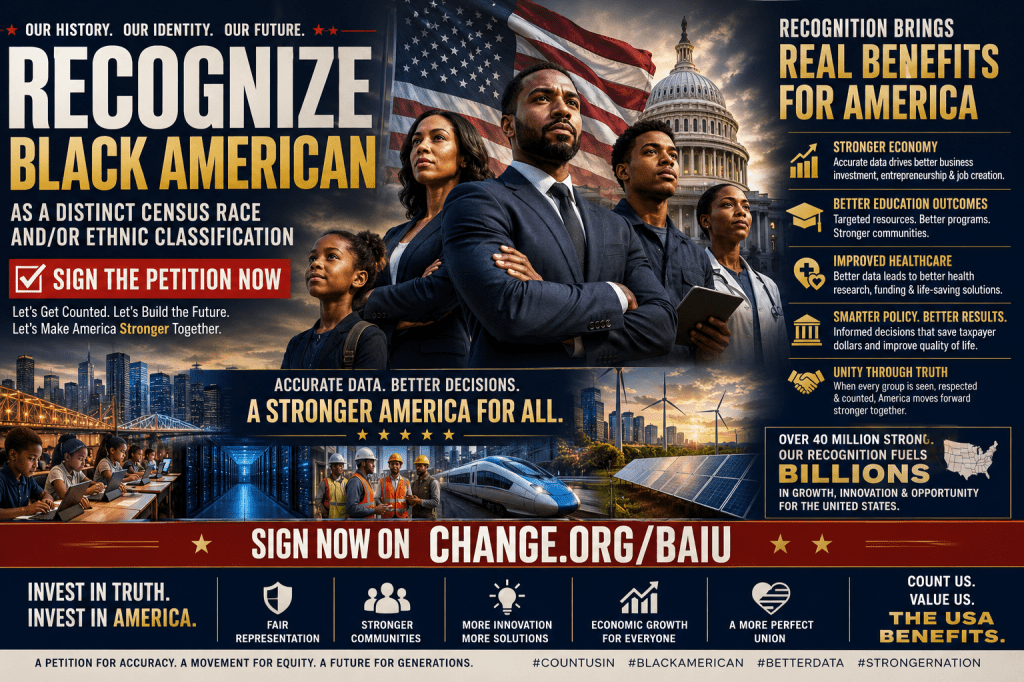
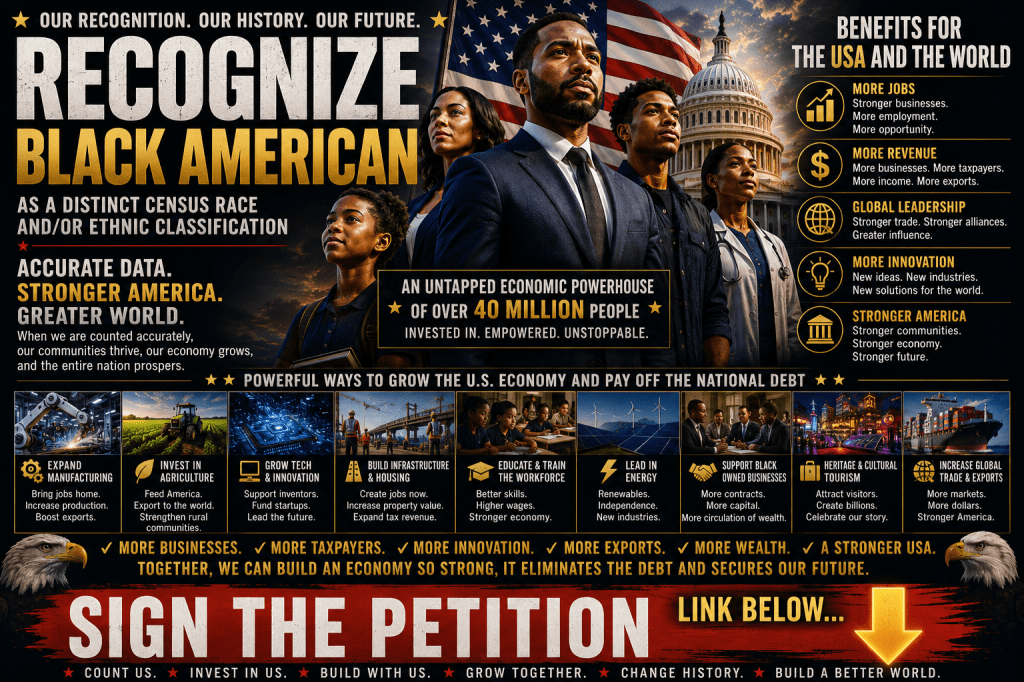
black american ethnicity defenition
Lineage and Ethnicity Definition
Core Definition
Black Americans- Black Americans are an ethnic community formed through a long process of ethnogenesis within the United States, shaped by generations of shared history, culture, survival, adaptation, and ancestral connections. The community includes diverse ancestral lineages and historical traditions surrounding Indigenous, Afro Indigenous, autochthonous, and aboriginal roots within the Americas.
Black Americans reflect a broad range of natural human features and skin tones, including tawny, copper, reddish brown, bronze, light cream, and deep melanated complexions, including rare cases of albinism and other naturally occurring genetic variations.
The community also carries historical memories and discussions surrounding displacement, reclassification, cultural erasure, and allegations of ethno genocide tied to various periods of American history, including changing census and social classifications such as Indian, Negro, Mulatto, Creole, Colored, Afro American, and African American.
This community is defined by multi generational presence, shared historical experience, and traceable connections to early American populations, including those shaped through slavery, colonial society, Indigenous interaction, and early nation building.
This community is defined by multi generational presence, shared historical experience, and traceable connection to early American populations, including those formed through slavery, colonial society, Indigenous interaction, and early nation building.
Historical Lineage Requirement
To qualify under this proposed definition, an individual must have at least one parent who is recognized as a Black American under this definition, and that qualifying parental lineage must trace to ancestors who were established within the United States on or before December 6, 1865, the date slavery was constitutionally abolished in the United States through the ratification of the Thirteenth Amendment.
To qualify under this proposed definition, an individual must:
- Have at least one parent who meets the definition of a Black American.
- Trace that qualifying parental lineage to ancestors who were established in the United States on or before December 6, 1865,.
- Identify with and maintain connection to the historic Black American ethnic community.
Historical Rationale for the December 6, 1865 Lineage Benchmark
The proposed historical lineage benchmark of December 6, 1865, is based on one of the most significant constitutional milestones in United States history. On that date, the Thirteenth Amendment to the United States Constitution was ratified, permanently abolishing slavery throughout the nation.
This date represents the constitutional beginning of a new historical era for the formerly enslaved population and their descendants. It marks the point at which millions of formerly enslaved people, along with free Black communities already established in the United States, entered a shared period of reconstruction, citizenship struggles, institution-building, and cultural development that contributed to the formation of the historic Black American ethnic community.
The rationale for using December 6, 1865, includes the following historical considerations:
- It is the first nationwide constitutional date marking the legal end of slavery in the United States.
- It provides a clear, objective, and historically recognized benchmark that can be consistently applied.
- It recognizes the unique ethnogenesis of a population whose identity developed over centuries within the United States through shared history, family networks, cultural traditions, language, survival, and community institutions.
- It distinguishes the historic Black American ethnic community from Black populations whose principal ancestral ties to the United States began through later voluntary immigration.
- It acknowledges that ethnic identity is shaped by historical development, not solely by race or skin color.
This proposed benchmark is not intended to diminish or invalidate the identities of African immigrants, Caribbean immigrants, Afro-Latino communities, or any other Black populations. Rather, it recognizes that multiple distinct ethnic communities can exist within the broader Black racial classification, each possessing its own historical origins, cultural development, and lineage.
Using December 6, 1865, as the historical benchmark provides a constitutionally significant, nationally recognized, and historically grounded point from which the historic Black American ethnic community may be identified for purposes of lineage recognition, demographic research, cultural preservation, and consideration as a distinct ethnic classification.
Race and Ethnicity
Race: Brown
Within the Black American International Union framework, the ancestral population of Black Americans is recognized as belonging to the Brown human family, reflecting the wide range of naturally occurring brown skin tones and the historical identity of the people from whom the community developed. “Brown” is used as a broad racial descriptor rather than as a nationality or ethnicity.
Ethnicity: Black American
Black Americans are an ethnic community formed through a long process of ethnogenesis within the United States, shaped by generations of shared history, culture, survival, adaptation, and ancestral connections. The community includes diverse ancestral lineages and historical traditions surrounding Indigenous, Afro Indigenous, autochthonous, and aboriginal roots within the Americas.
Lineage
Membership is based upon documented or verified ancestral lineage connected to the historic Black American population established within the United States over multiple generations.
Historical Reference (1828 Webster Definition)
According to Noah Webster’s 1828 American Dictionary of the English Language, the term “American” was defined as:
“A native of America; originally applied to the aboriginals, or copper-colored races, found here by the Europeans; but now applied to the descendants of Europeans born in America.”
| Category | Description |
|---|---|
| Race | Brown |
| Ethnicity | Black American |
| Nationality | 1828 American |
| Ancestry/Lineage | Family ancestry connected to the historic Black American population |
| Citizenship | United States |
Lineage Criteria
A person may be identified as a Black American if they meet one or more of the following lineage connections:
1. Transatlantic Lineage
- Descendants of individuals impacted by the Transatlantic Slave Trade within what became the United States
2. Indigenous and Autochthonous Lineage
- Individuals whose ancestry is connected to historically documented Black or African descended populations present in the Americas prior to and during early European contact
- Individuals connected to Indigenous or autochthonous populations of North America whose classification has changed over time through legal and social systems
3. Early American Black Populations
- Descendants of free or enslaved Black populations recorded in colonial and early United States documents
- Individuals connected to populations present during early European settlement and expansion
4. Historically Recognized Communities
Including, but not limited to:
- Freedmen communities
- Black Seminoles
- Buffalo Soldiers
- Black Indigenous or mixed heritage populations documented in early American history
Historical Classification and Reclassification
Black Americans are a people whose identity has been shaped through documented systems of classification and reclassification over time.
Historically, members of this lineage have been recorded under various terms, including:
- “Indian”
- “Negro”
- “Mulatto”
- “Creole”
- “Colored”
- “Black”
- “African American”
These classifications shifted across different time periods due to legal definitions, census practices, and social structures, rather than consistent self identification.
Ethnogenesis
Black Americans represent a process of ethnogenesis, meaning the development of a distinct people over time through:
- Shared historical conditions
- Cultural blending and adaptation
- Language formation and communication systems
- Social, economic, and political experience within the United States
This process reflects the emergence of a unique identity rooted in the American experience
The Black American people represent the product of a long-term process of ethnogenesis occurring within the American continent through the interaction of ancestry, kinship, territorial attachment, collective memory, cultural transmission, institutional continuity, and historical development.
From an ethnological perspective, Black Americans are not merely a demographic category, racial classification, or political designation. Black Americans constitute a historical population whose identity emerged through centuries of social reproduction, community formation, territorial development, and cultural continuity within America.
The ethnogenesis of Black Americans must therefore be understood as the formation of a people rather than the classification of a population.
Black Americans as a Historical Population
Anthropologists recognize that populations become peoples when biological continuity becomes linked to collective memory, social institutions, territorial consciousness, and cultural inheritance.
The development of Black Americans reflects such a process.
Over generations, Black Americans established families, communities, churches, schools, businesses, agricultural systems, cultural traditions, educational institutions, mutual aid networks, and economic structures that contributed to the formation of a distinct historical community.
Through this process, Black Americans became connected not only through ancestry but through a shared historical experience rooted within America itself.
The Biological and Cultural Reproduction of Black Americans
The continuity of Black Americans has been maintained through two interconnected systems of inheritance.
The first system is biological inheritance.
The second system is cultural inheritance.
Biological inheritance transmits ancestry through generations.
Cultural inheritance transmits language, values, traditions, beliefs, knowledge, historical memory, social norms, and collective identity.
The survival of Black Americans as a people depended upon the simultaneous reproduction of both systems across centuries.
Through family formation and community continuity, Black Americans reproduced themselves not only as individuals but as a distinct historical community.
Black Americans and Territorial Consciousness
A defining characteristic of ethnogenesis is the development of a relationship between a people and a homeland.
Throughout generations, Black Americans established deep connections to specific regions, watersheds, agricultural lands, settlements, towns, counties, burial grounds, churches, educational institutions, and cultural centers throughout America.
These territorial relationships became embedded within Black American collective memory.
The land became part of Black American history, and Black American history became part of the land.
This process contributed to the development of a territorial consciousness that linked generations of Black Americans to particular places and landscapes across America.
Black Americans and the Principle of Autochthony
The concept of autochthony refers to the understanding that a people possesses deep historical roots within a particular homeland.
Within autochthonous interpretations of Black American ethnogenesis, Black Americans are understood as a people whose historical development is inseparable from the American continent itself.
This perspective proposes that the identity of Black Americans cannot be understood solely through recent historical periods but must also be examined through questions of long-term territorial continuity, Indigenous relationships to land, ancestral memory, population formation, and cultural persistence.
Under this framework, Black Americans are viewed as participants in a much deeper historical process connected to the development of human communities within America.
Black Americans and Indigenous Continuity
Certain interpretations of Black American ethnogenesis argue that elements of Black American ancestry may preserve continuity with populations historically described throughout the Americas as copper-colored, tawny, brown, bronze, or dark-complexioned.
Advocates of this perspective point to historical descriptions recorded by explorers, missionaries, military officers, naturalists, cartographers, and early lexicographers who documented significant physical diversity among Indigenous populations throughout the American continents.
Within this framework, Black Americans are viewed not merely as descendants of recent historical populations but as participants in a broader process of demographic continuity, cultural transformation, and identity preservation occurring within America across long periods of time.
While the degree and nature of such continuity remain subjects of historical investigation and debate, the theory emphasizes the possibility of deeper ancestral relationships between Black Americans and ancient populations of the Americas.
Black Americans and Collective Memory
A people exists because it remembers.
Collective memory is the mechanism through which Black Americans maintain continuity across generations.
Through oral history, family traditions, religious institutions, community narratives, historical records, cultural practices, and shared experiences, Black Americans preserved memories that linked the living to their ancestors and future generations.
Collective memory transformed ancestry into identity and identity into peoplehood.
Black Americans and Identity Consolidation
Ethnogenesis reaches maturity when a population develops a durable understanding of itself as a distinct historical people.
For Black Americans, this process emerged through centuries of biological continuity, family formation, institutional development, cultural innovation, territorial attachment, collective memory, and social organization.
Over time, Black Americans developed a shared historical consciousness that connected diverse communities into a broader national and ethnic identity.
This identity became capable of reproducing itself across generations regardless of political, economic, or social change.
Conclusion
Through the processes of biological continuity, cultural transmission, social reproduction, territorial attachment, institutional development, collective memory, and identity consolidation, Black Americans emerged as a distinct historical people.
Within autochthonous interpretations, Black Americans are understood not simply as a modern demographic population but as a people whose origins, development, memory, and historical consciousness are deeply connected to America itself.
Black American ethnogenesis represents the convergence of ancestry, land, culture, memory, and civilization into an enduring people whose past, present, and future are inseparable from the American continent..
Language, Cultural Influence, and American English
Black Americans have played a significant role in shaping the linguistic and cultural landscape of the United States.
Through generations of interaction among African descended populations, Indigenous communities, and European settlers, Black Americans contributed to the development and evolution of communication systems that influenced what is now known as American English.
This includes:
- The use of pidgin and trade languages for communication across diverse populations
- The formation of Creole speech traditions in regions where African, Indigenous, and European influences intersected
- The use of Tutenese, a coded speech system developed within Black communities
- The preservation and development of regional traditions such as Gullah Geechee
- Contributions to vocabulary, speech patterns, rhythm, and expression that have influenced broader American communication
These linguistic contributions reflect cultural continuity, adaptation, and identity formation across generations.
Language, Cultural Formation, and Influence on American English
Black Americans have played a significant role in the development, adaptation, and cultural shaping of language within the United States.
Through generations of interaction among different populations of people. Black Americans participated in the formation of communication systems that contributed to what is now recognized as American English.
Historical Identity and the Meaning of “American”
Within the Black American community, there is recognition that the meaning of the term “American” has changed over time.
Historical dictionary sources, including early editions of Webster’s Dictionary, defined “American” in reference to the Indigenous inhabitants of the Americas, describing the copper colored original peoples of North, Central, and South America.
Over time, the definition of “American” expanded through legal, social, and linguistic developments to include all citizens of the United States.
The Black American perspective acknowledges these documented shifts and affirms a connection to early American identity as part of the broader historical narrative of the Americas.
Historical Scope
Black Americans are historically connected to:
- Early and precolonial populations of the Americas
- Colonial societies and early American settlements
- The development of the United States
- Participation in major conflicts and nation building efforts across North America
- Rural and urban community formation throughout American history
Identity and Recognition of Foundational Black American identity is:
- Lineage based
- Historically grounded
- Formed through documented and lived experience within the United States
This definition affirms the right of Black Americans to define their ethnic identity based on ancestry, history, and cultural development.
Positioning Statement
The Black American classification is not solely based on modern racial categories, but on lineage, historical continuity, ethnogenesis, and documented presence within the American context, including connections to Indigenous, autochthonous, and early American populations.
Language Formation and Communication Systems
Throughout early American history, Black Americans utilized and developed multiple forms of communication across diverse and often restrictive environments. These included:
- Pidgin and trade languages, used for communication, negotiation, and exchange among populations with different linguistic backgrounds
- Creole speech traditions, particularly in regions such as Louisiana, the Carolinas, and coastal areas, where African, Indigenous, French, Spanish, and English influences combined to form distinct language systems
- Tutenese, also referred to as Tut language, a coded form of speech used within some Black communities to communicate privately and maintain cultural autonomy
- Regional linguistic traditions, including Gullah Geechee, which preserves elements of African, Indigenous, and colonial language structures
- Contact languages, formed through sustained interaction among Indigenous peoples, African descended populations, and European settlers across the Americas
Influence on American English
Through these linguistic systems and cultural exchanges, Black Americans contributed to the evolution of American English, including:
- The development of vocabulary and expressions adopted into broader American usage
- Distinct speech patterns, rhythm, and intonation that influenced regional and national communication styles
- Cultural forms of expression, storytelling, and oral tradition that shaped American identity and communication
These contributions reflect not only adaptation under historical conditions, but also innovation, creativity, and continuity across generations.
Cultural Significance
Language within the Black American community represents more than communication. It reflects:
- Cultural preservation and transmission
- Adaptation to changing social and legal environments
- Identity formation through shared expression and experience
- The development of coded and protected forms of communication under restrictive conditions
Positioning Statement
The linguistic contributions of Black Americans are a foundational component of American culture and communication. These contributions continue to influence the evolution of American English and reflect the broader historical role of Black Americans in shaping the United States.
 BAIU
BAIU 