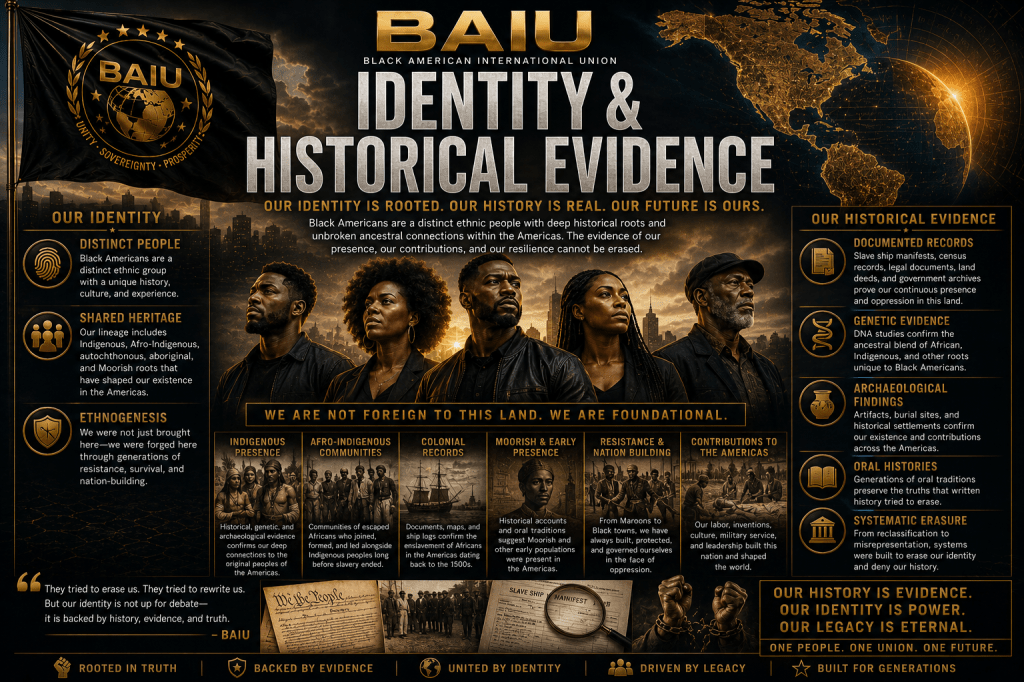
Identity and Historical Evidence
Overview
Black American identity is established through documented records, historical classification systems, legal structures, cultural continuity, and multi generational presence within the United States.
This page presents evidence across these areas to demonstrate continuity of identity before, during, and after the development of America and the United States.
1. Historical Records
Documented records form the primary basis of identity.
These include:
- Census records
- Birth and death records
- Marriage records
- Military records
- Land and property records
- Court and legal documents
These records confirm continuous presence across generations within the United States.
2. Census and Classification Systems
Throughout American history, populations connected to Black Americans were recorded under changing classifications.
These include:
- Indian
- Negro
- Mulatto
- Creole
- Colored
- Black
- African American
Key Principle
Classification reflects administrative and legal recording systems.
It does not define lineage.
3. Multi Generational Presence
A defining characteristic is long term presence within the United States.
This includes:
- Families documented across multiple generations
- Continuous residence in specific regions
- Development of established communities
This demonstrates continuity across all phases of American development.
4. Military Records as Evidence
Military records provide documented proof of presence and participation.
This includes:
- Revolutionary War
- Civil War and United States Colored Troops
- Buffalo Soldiers
- World War I and II
- Modern military service
These records confirm involvement across major historical periods.
5. Early Descriptions of Indigenous Peoples
Early European observers often described Indigenous populations using physical terms common to their era. Among the most frequently recorded descriptions were:
• Copper colored
• Tawny
• Bronze
• Brown
• Reddish brown
• Dark complexioned
These descriptions appeared in travel journals, colonial reports, military records, missionary accounts, natural history writings, and early dictionaries.
Because terminology varied from one observer to another, there was no single universal description. Different nations and communities throughout the Americas possessed a wide range of appearances, cultures, languages, and traditions. reflect observational language used during that time.
Context
- Terminology varied by author and region
- Descriptions were not standardized
- Language differs from modern classification systems
6. Legal and Social Control Systems
American Colonization Society
The American Colonization Society promoted the relocation of free Black Americans outside the United States.
Historical Significance
- Demonstrates organized efforts to remove or relocate Black populations
- Reflects recognition of established communities
- Shows political and social control over identity
Tignon Laws
Enacted in Louisiana during the late 1700s, these laws required Black women, particularly free women of color, to wear head coverings.
Expanded Restrictions and Ordinances
These laws existed within a broader system of regulation that controlled:
- Hair presentation
- Use of beads and decorative jewelry
- Display of feathers and adornments
- Clothing associated with status
- Public appearance and expression
Carnival and Public Conduct Restrictions
Additional ordinances restricted:
- Participation in Carnival
- Public dancing and gatherings
- Cultural expression in public spaces
- Social interaction across groups
Restrictions applied to both men and women to regulate behavior and visibility.
Purpose of These Laws
These regulations were designed to:
- Control identity and visibility
- Limit expressions of status and culture
- Reinforce social hierarchy
- Prevent perceived challenges to authority
Historical Significance
These systems demonstrate:
- Established Black communities
- Visible cultural expression
- Legal attempts to regulate identity
7. Risks of Identity Assertion
Throughout American history, individuals classified under Black categories faced consequences when asserting Indigenous or alternative identity.
These risks included:
- Legal disputes
- Loss of rights or status
- Forced reclassification
- Social and political pressure
Context
Identity was shaped through:
- Law
- Policy
- Social hierarchy
Claims of identity could directly affect legal standing and rights.
8. Cultural and Community Continuity
Identity is also reflected through:
- Language systems
- Family structures
- Oral traditions
- Regional communities
These elements demonstrate continuity beyond written documentation.
9. Documentation for Verification
Lineage is supported through multiple forms of documentation:
- Census records
- Church records
- Military records
- Birth and death certificates
- Land ownership records
- Family documentation and oral history
10. Historical Interpretation and Cross Cultural Context
Some areas remain under continued study and interpretation.
These include:
- Ancient American civilizations
- Monumental works such as Olmec heads
- Mound builder societies
- Shifts in classification over time
Moorish Historical Context
Moorish populations were historically present in North Africa and parts of Europe, particularly the Iberian Peninsula.
Their influence is well documented in those regions.
Extended Interpretations
Some perspectives explore broader movement, contact, or cultural exchange beyond these regions, including the Americas.
These interpretations are part of ongoing research and are not uniformly established within mainstream scholarship.
Positioning Statement
This material is included to reflect the broader context of global movement and historical complexity.
It is presented as part of ongoing inquiry.
11. The Meaning of “American”
Historical sources, including early editions of Webster’s Dictionary, defined “American” in reference to the Indigenous inhabitants of the Americas.
Over time, the definition expanded to include all citizens of the United States.
12. Continuity of Identity
Identity is established through:
- Documented lineage
- Historical presence
- Cultural continuity
- Multi generational existence
Final Statement
Black American identity is supported by documented records, legal history, cultural continuity, and continuous presence across generations.
This identity reflects a people whose presence is established within the history and development of America.

