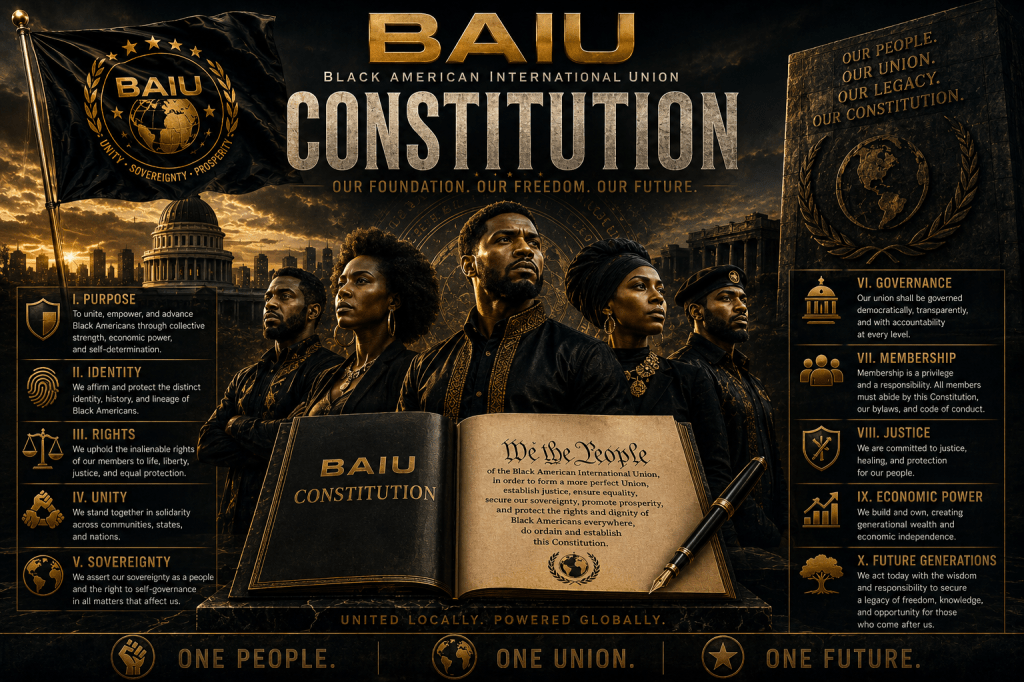
Constitution of the Foundational Black American People
Preamble
We, the Black Americans, a distinct lineage based people with continuous historical presence before, during, and after the development of America and the United States, do establish this Constitution to affirm our identity, preserve our heritage, and organize for recognition, unity, advancement, and collective power.
Rooted in precolonial presence, shaped through colonial transformation, and sustained through generations within the United States, we recognize ourselves as a people formed through shared history, cultural development, and enduring continuity.
We assert our right to define our lineage, our identity, and our place within both the historical and present reality of America.
Article I: Identity and Peoplehood
Section 1.
Black Americans are a distinct lineage based ethnic community and people within the United States, with continuity before, during, and after the development of America.
Section 2.
This identity is grounded in:
- Multi generational presence across precolonial, colonial, and modern America
- Shared historical experience before, during, and after the formation of the United States
- Cultural, linguistic, and social development within the American context
Section 3.
This Constitution affirms the inherent right of Black Americans to define, preserve, and advance their identity across all historical periods of America.
Article II: Lineage Foundation
Section 1.
Black American identity is based on lineage, historical continuity, and shared experience extending before, during, and after the development of America.
Section 2.
This lineage includes, but is not limited to:
- Descendants of individuals impacted by the Transatlantic Slave Trade within the territory that became the United States
- Descendants of early Black populations present in the Americas before and during European contact
- Individuals connected to Indigenous and autochthonous populations whose classification has shifted over time
- Populations historically recorded across North, Central, and South America across multiple historical periods
Section 3.
Lineage recognition may be supported through documentation, historical record, cultural continuity, or community identification.
Article III: Historical Classification and Reclassification
Section 1.
Black Americans have been subject to evolving systems of classification before, during, and after the development of America.
Section 2.
These classifications have included, but are not limited to:
- Indian
- Negro
- Mulatto
- Creole
- Colored
- Black
- African American
Section 3.
These classifications were shaped by legal, economic, and social systems across different historical periods, resulting in processes of reclassification over time.
Article IV: Ethnogenesis and Cultural Formation
Section 1.
Black Americans represent a process of ethnogenesis occurring across multiple historical periods before, during, and after the development of America.
Section 2.
This process includes:
- Cultural blending and adaptation
- Development of shared traditions and identity
- Formation of community structures and survival systems
- Continuity across generations within the Americas
Article V: Language, Communication, and Cultural Influence
Section 1.
Black Americans have contributed to the formation, adaptation, and cultural development of language before, during, and after the development of America.
Section 2.
This includes the development and use of:
- Pidgin and trade languages for communication across populations
- Creole speech traditions formed through African, Indigenous, and European interaction
- Tutenese and other coded communication systems
- Regional linguistic traditions such as Gullah Geechee
- Contact languages developed through sustained interaction among populations
Section 3.
These linguistic systems contributed to the evolution of American English across generations.
Section 4.
Language reflects cultural preservation, adaptation, and identity formation within the Foundational Black American community.
Article VI: Historical Identity and the Meaning of “American”
Section 1.
The meaning of the term “American” has changed over time before, during, and after the development of the United States.
Section 2.
Historical sources, including early editions of Webster’s Dictionary, defined “American” in reference to the Indigenous inhabitants of the Americas.
Section 3.
These early definitions described the original peoples of North, Central, and South America.
Section 4.
Over time, the definition expanded through legal, social, and linguistic developments to include all citizens of the United States.
Section 5.
This Constitution acknowledges these documented shifts and affirms a connection to early American identity.
Article VII: Pre and Present Historical America
Section 1. Continuity
America is recognized as a continuous historical reality extending before, during, and after its development as a nation.
Section 2. Precolonial America
Precolonial America consisted of diverse populations present before European arrival.
Section 3. Colonial Transformation
The colonial period introduced structural changes, including:
- European expansion
- Colonial legal systems
- The Transatlantic Slave Trade
- Reclassification of populations
Section 4. Formation of the United States
Black Americans were present during the formation of the United States and contributed to its development.
Section 5. Reclassification
Identity classifications shifted across different historical periods.
Section 6. Present Day
Black Americans continue as a lineage based community within modern America.
Section 7. Integrated Understanding
Pre and Present Historical America affirms continuity across all historical phases.
Article VIII: Historical Scope and Contribution
Section 1.
Black Americans are connected to:
- Precolonial populations
- Colonial societies
- The development of the United States
- Major conflicts and nation building efforts
- Community formation across generations
Section 2.
These contributions form part of the foundation of American society.
Article IX: Unity and Collective Responsibility
Section 1.
Black Americans share responsibility for preserving identity and advancing collective interests.
Section 2.
Unity shall be pursued through discipline, cooperation, and shared purpose.
Article X: Recognition and Self Determination
Section 1.
Black Americans assert the right to self definition and recognition.
Section 2.
This Constitution affirms lineage based identity as a legitimate foundation for recognition.
Article XI: Future Institutional Development
Section 1.
This Constitution serves as the foundation for future organizations and institutions.
Section 2.
Such structures shall align with the principles defined herein.
Article XII: Amendments
Section 1.
This Constitution may be revised as needed.
Section 2.
Amendments shall follow a structured process.
Article XIII: Adoption
This Constitution is established as the foundational document of the Black American people.

