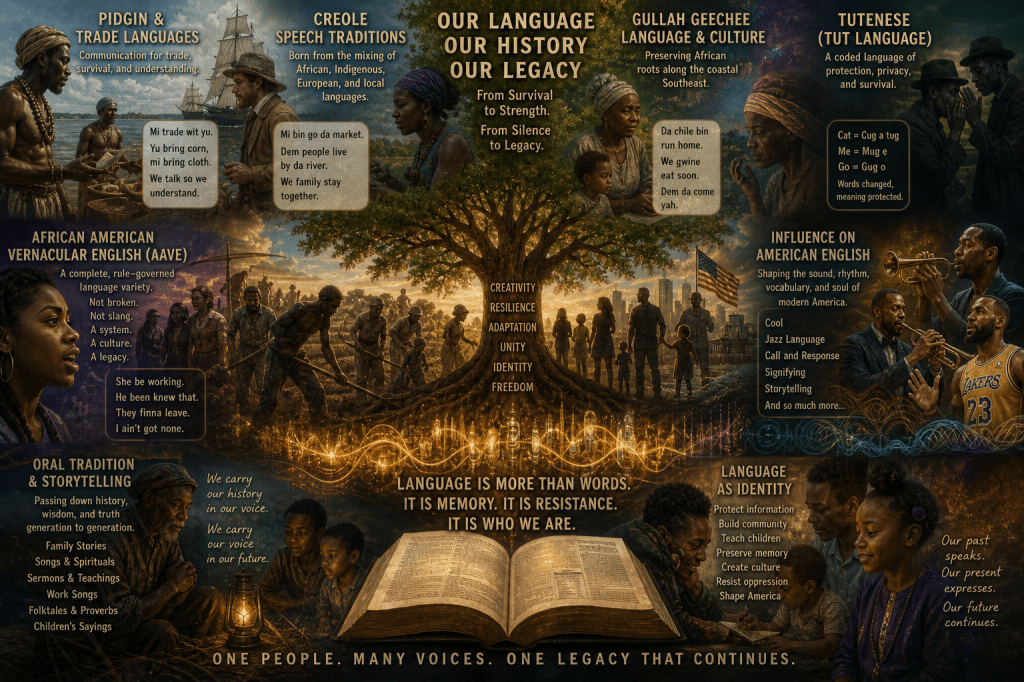
Language
Language and Cultural Development
Language has always been part of Black American survival, identity, trade, secrecy, family life, and cultural creation.
Across time, Black Americans interacted with African, Indigenous, European, and American born communities. Through those interactions, different forms of speech, coded language, regional dialects, and cultural expressions developed.
1. Pidgin and Trade Languages
Pidgin and trade languages developed when different groups needed to communicate for trade, labor, movement, negotiation, and daily survival.
Example Style
Mi trade wit yu.
Meaning: I trade with you.
Yu bring corn, mi bring cloth.
Meaning: You bring corn, I bring cloth.
We talk so we understand.
Meaning: We speak in a way we both understand.
2. Creole Speech Traditions
Creole languages and speech traditions formed where African, Indigenous, European, and local American communities interacted over generations.
These traditions were especially important in places such as Louisiana, the Carolinas, the coastal South, and other regions shaped by cultural mixture.
Example Style
Mi bin go da market.
Meaning: I went to the market.
Dem people live by da river.
Meaning: Those people live by the river.
We family stay together.
Meaning: Our family stays together.
3. Gullah Geechee Language and Culture
Gullah Geechee developed among Black communities along the coastal Southeast, especially in areas of South Carolina, Georgia, Florida, and North Carolina.
It preserves African influenced grammar, rhythm, vocabulary, and oral tradition.
Example Style
Da chile bin run home.
Meaning: The child ran home.
We gwine eat soon.
Meaning: We are going to eat soon.
Dem da come yah.
Meaning: They are coming here.
4. Tutenese / Tut Language
Tutenese, also called Tut language, is remembered as a coded speech system used by some Black communities for privacy, protection, and communication.
It was not just language, it was a survival tool.
Example Style
A simple word could be stretched with coded sounds so outsiders could not easily understand it.
Cat could become:
Cug a tug
Me could become:
Mug e
Go could become:
Gug o
This shows how ordinary speech could be transformed into protected communication.
5. African American Vernacular English
African American Vernacular English, often called AAVE, is a major language variety shaped within Black American communities.
It has grammar, rhythm, structure, meaning, and cultural rules. It is not broken English. It is a real speech system with deep historical roots.
Example Style
She be working.
Meaning: She works regularly or habitually.
He been knew that.
Meaning: He has known that for a long time.
They finna leave.
Meaning: They are about to leave.
I ain’t got none.
Meaning: I do not have any.
6. Influence on American English
Black Americans helped shape the sound, rhythm, vocabulary, storytelling, and expression of American English.
Many parts of modern American speech, music, comedy, sports talk, preaching, political speech, and popular culture have been influenced by Black American language traditions.
Examples of Influence
Cool
Used widely in American speech and strongly popularized through Black music and culture.
Jazz language
Words, rhythm, call and response, improvisation, and expressive speech influenced broader American culture.
Call and response
A communication style used in churches, music, speeches, and public gatherings.
Signifying
A form of indirect verbal expression, wit, critique, humor, and layered meaning.
7. Oral Tradition and Storytelling
Language was also preserved through spoken memory.
Black American communities passed down:
Family stories
Songs
Spirituals
Sermons
Work songs
Children’s sayings
Folktales
Proverbs
These oral traditions carried history when written records were denied, destroyed, or controlled by others.
8. Language as Identity
Language helped Black Americans:
Protect information
Build community
Teach children
Preserve memory
Create culture
Resist oppression
Shape American identity
Closing Statement
The language history of Black Americans shows creativity, intelligence, survival, and cultural power.
From trade speech and Creole traditions to Tutenese, Gullah Geechee, African American Vernacular English, and modern American English influence, Foundational Black Americans helped shape how America speaks, sings, teaches, jokes, preaches, organizes, and remembers.

