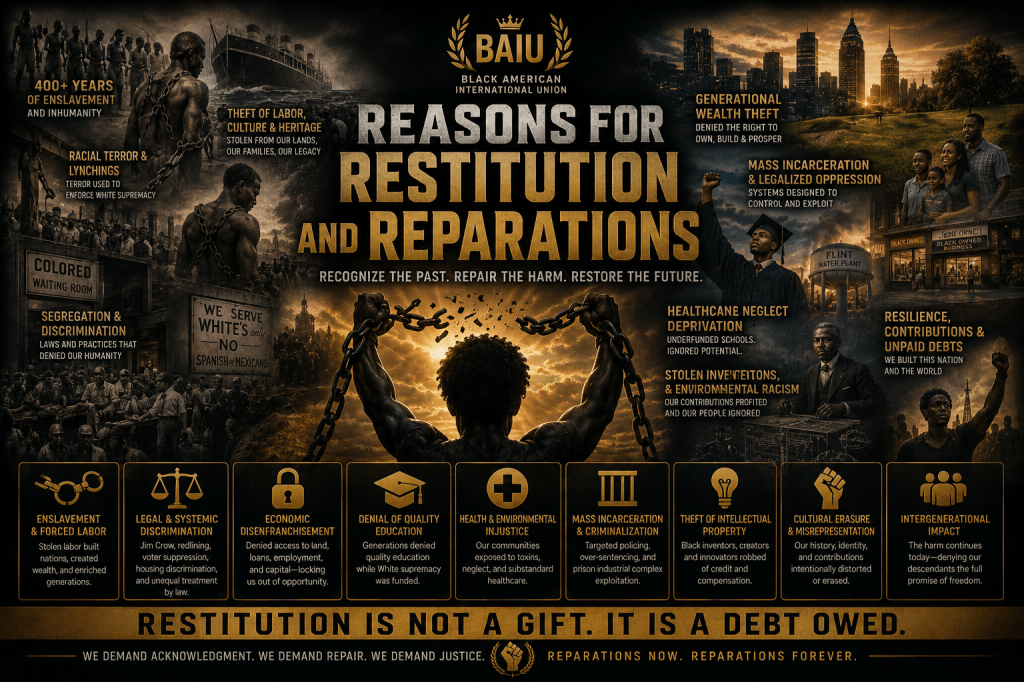
1. Uncompensated Labor
For centuries, enslaved Black Americans generated enormous economic value through forced labor while receiving no wages, property rights, or accumulated wealth.
Key argument:
- Wealth was extracted from generations of labor.
- The benefits of that labor helped build agricultural, industrial, financial, and governmental institutions.
- Descendants inherited the loss of wealth while others inherited the gains.
2. Wealth Stripping After Emancipation
The end of slavery did not result in broad land redistribution or economic restitution.
Examples often cited:
- Failure to provide promised land ownership opportunities.
- Debt peonage and sharecropping systems.
- Limited access to capital and banking.
Key argument:
- Freedom was granted without the economic foundation necessary for long-term self-sufficiency.
3. Systematic Exclusion from Wealth-Building Programs
Throughout the 19th and 20th centuries, many Black Americans faced barriers to programs that helped build the modern middle class.
Examples commonly discussed by historians:
- Housing discrimination.
- Unequal lending practices.
- Unequal educational opportunities.
- Segregation-era restrictions.
Key argument:
- Many wealth-building systems were available in theory but were not equally accessible in practice.
4. Intergenerational Effects
Economic and social disadvantages can compound across generations.
Research frequently shows connections between:
- Family wealth.
- Educational opportunities.
- Home ownership.
- Business ownership.
- Inheritance.
Key argument:
- Harm occurring across multiple generations can create long-term disadvantages even after discriminatory laws are removed.
5. Destruction of Black Communities and Businesses
Numerous Black communities experienced economic disruption through violence, discriminatory policies, urban renewal projects, highway construction, and unequal investment.
Key argument:
- Productive communities lost land, businesses, tax bases, and opportunities for generational wealth transfer.
6. Restitution as a General Legal Principle
Across many legal systems, restitution is a recognized principle when identifiable harms have occurred.
Key argument:
- If a wrong creates measurable losses, some form of compensation or restoration may be justified.
- Reparations are viewed by supporters as an extension of this principle to historical harms.
7. Closing Historical Wealth Gaps
Supporters argue that reparations are not solely about the past but about addressing measurable present-day consequences.
Key argument:
- Historical injustices contributed to disparities in:
- Wealth
- Home ownership
- Business ownership
- Access to capital
8. Recognition of a Distinct Historical Community
Many scholars describe Black Americans as a population formed through a unique historical process within the United States.
Factors include:
- Shared ancestry connected to slavery and segregation.
- Common cultural development.
- Shared historical experiences.
- Distinct traditions, language patterns, music, cuisine, and social institutions.
Key argument:
- The claim is not merely individual but concerns a historically identifiable community that experienced collective harms.
9. National Reconciliation
Some proponents view reparations as a process of acknowledgment and repair.
Key argument:
- Public recognition of historical harms may strengthen social trust and national unity.
- Restorative programs can serve as investments in long-term stability.
10. Restorative Development Rather Than Cash Payments Alone
Many modern proposals focus on rebuilding rather than direct payments.
Potential areas:
- Education funds
- Housing initiatives
- Business investment funds
- Infrastructure development
- Agricultural programs
- Health initiatives
- Community banking institutions
Key argument:
- The goal is to build long-term productive capacity rather than provide only one-time compensation.
11. Forced Racial Reclassification
One argument is that governments and institutions repeatedly altered the official classification of populations through censuses, birth records, court rulings, and administrative policies.
Supporters of this theory argue that:
- Identity categories were sometimes imposed rather than self-determined.
- Families may have been reclassified across generations.
- Records were altered in ways that obscured ancestral origins and tribal affiliations.
- Government categories often changed according to political priorities rather than lineage.
The theoretical harm is not only economic but genealogical—the loss of documented ancestry and historical identity.
12. Loss of Historical Continuity
Many populations preserve identity through uninterrupted records, language, family archives, and community institutions.
Black Americans often experienced:
- Family separation.
- Record destruction.
- Name changes.
- Disrupted kinship systems.
- Incomplete ancestral documentation.
The argument is that an entire people suffered interruptions in historical continuity that make lineage reconstruction far more difficult than for many other populations.
13. Cultural Extraction Without Compensation
Many aspects of American culture emerged from Black American communities.
Examples commonly cited include:
- Musical innovations.
- Agricultural knowledge.
- Culinary traditions.
- Linguistic contributions.
- Fashion and artistic forms.
The argument is that substantial cultural value was extracted and commercialized while the originating communities often received limited economic return.
14. Suppression of Community Institutions
Historically, numerous Black schools, businesses, newspapers, hospitals, banks, and civic organizations faced barriers to growth.
The theoretical claim is that:
- Community institution-building was repeatedly disrupted.
- Long-term organizational capital was weakened.
- Economic independence was delayed.
The resulting loss extends beyond individuals to entire community ecosystems.
15. Unequal Protection of Property Rights
A core function of government is protecting property ownership.
Many reparations advocates argue that Black Americans frequently experienced:
- Land loss.
- Fraudulent transfers.
- Discriminatory taxation.
- Unequal legal enforcement.
- Barriers to title protection.
The theory holds that when governments fail to protect property equally, restitution may be justified.
16. Demographic Development Interrupted
Many groups build wealth through uninterrupted community growth.
Black American development was affected by:
- Slavery.
- Segregation.
- Displacement.
- Mass incarceration.
- Economic exclusion.
The argument is that normal demographic development was repeatedly interrupted, affecting population stability, inheritance patterns, and community formation.
17. Loss of Indigenous and Local Knowledge Systems
Some researchers and community historians argue that portions of the Black American population may possess ancestry connected to Indigenous populations of the Americas, whether through direct descent, cultural exchange, or long-standing regional interaction.
Under this theory:
- Reclassification and racial categorization may have obscured these connections.
- Local histories may have been lost.
- Community memory may have been weakened.
Supporters argue that if identities were altered administratively, restoration efforts should include historical investigation and documentation.
18. Government-Created Dependency Through Exclusion
Some advocates argue that centuries of exclusion from land ownership, capital access, and economic participation contributed to long-term dependency on external institutions.
The argument is that:
- Communities were denied normal wealth-building opportunities.
- Dependency was not naturally occurring.
- Structural barriers helped create it.
Restorative development is therefore viewed as correcting historical distortions rather than providing special treatment.
19. Collective Harm Beyond Individual Harm
Many legal systems recognize that harm can affect groups as well as individuals.
Examples include:
- Cultural destruction.
- Loss of language.
- Community displacement.
- Identity suppression.
The theoretical argument is that even when specific victims are difficult to identify generations later, collective injury can still justify collective remedies.
20. Historical Record Distortion
Some scholars and activists argue that official narratives have not always fully represented Black American history.
Examples cited include:
- Underrepresentation in textbooks.
- Incomplete treatment of local histories.
- Limited preservation of community archives.
- Disputed interpretations of ancestry and identity.
The argument is that historical restoration itself is a form of restitution.
21. Disproportionate Criminal Justice Burdens
Many scholars argue that Black Americans have historically experienced disproportionate contact with the criminal justice system.
Arguments often include:
- Sentencing disparities.
- Unequal enforcement patterns.
- Differential prosecution rates.
- Unequal access to legal resources.
- Long-term consequences of criminal records.
Theoretical harm:
Not only incarceration itself, but the resulting loss of income, property accumulation, family stability, and political participation across generations.
22. The War on Drugs as Community Destabilization
Critics of drug policy argue that enforcement strategies beginning in the late 20th century had particularly severe impacts on many Black American communities.
Arguments include:
- Large-scale incarceration.
- Family separation.
- Reduced economic opportunity.
- Community destabilization.
- Concentrated policing.
Theoretical harm:
Entire neighborhoods losing working-age adults, weakening local economic and social structures.
23. Environmental Exposure and Industrial Placement
Researchers have documented that minority and lower-income communities have often been located closer to:
- Industrial facilities.
- Refineries.
- Waste sites.
- Heavy transportation corridors.
Theoretical harm:
- Increased exposure to pollutants.
- Chronic health effects.
- Reduced property values.
- Higher medical costs.
Supporters argue that environmental restoration can be viewed as a form of reparative justice.
24. Water Infrastructure Inequities
Some communities have experienced prolonged issues involving:
- Aging water systems.
- Lead contamination.
- Poor infrastructure maintenance.
- Unequal investment.
Theoretical harm:
- Neurological impacts.
- Health disparities.
- Educational effects.
- Long-term economic costs.
The argument is that public infrastructure failures can create generational consequences.
25. Air Quality and Public Health Burdens
Studies have found that some historically marginalized communities experience higher exposure to:
- Particulate pollution.
- Vehicle emissions.
- Industrial emissions.
Potential impacts include:
- Asthma.
- Cardiovascular disease.
- Reduced life expectancy.
- Lost productivity.
Theoretical harm:
Health burdens that compound across generations.
26. Educational Resource Inequality
A common argument centers on unequal educational opportunities resulting from:
- School funding disparities.
- Segregation.
- Unequal facilities.
- Resource limitations.
Theoretical harm:
- Reduced earning potential.
- Lower access to advanced opportunities.
- Intergenerational effects on wealth and mobility.
27. Public Health Neglect
Some scholars argue that historically underserved communities received less investment in:
- Hospitals.
- Preventive care.
- Maternal health.
- Mental health services.
- Nutrition programs.
Theoretical harm:
- Shortened lifespans.
- Increased disease burdens.
- Higher mortality rates.
28. Property Devaluation Through Policy Decisions
Infrastructure projects such as highways, zoning decisions, and redevelopment programs have sometimes disproportionately affected Black neighborhoods.
Potential consequences:
- Reduced property values.
- Displacement.
- Business losses.
- Neighborhood fragmentation.
Theoretical harm:
Lost opportunities for wealth accumulation through real estate.
29. Psychological and Social Stress Burdens
Researchers studying chronic stress have examined the effects of:
- Economic insecurity.
- Discrimination.
- Community instability.
- Exposure to violence.
Potential consequences:
- Mental health impacts.
- Physical health effects.
- Reduced educational and occupational outcomes.
Theoretical harm:
Long-term biological and social costs associated with chronic stress exposure.
30. Generational Opportunity Costs
A broader argument focuses on opportunities that were never realized because of historical barriers.
Examples include:
- Businesses never created.
- Land never acquired.
- Inventions never funded.
- Educational paths never pursued.
- Investments never made.
Theoretical harm:
Not only what was taken, but what could have been built.
31. Non-Consensual Medical Experimentation
Historically, Black Americans were sometimes subjected to medical research without modern standards of informed consent.
Examples often cited include:
- Tuskegee Syphilis Study
- Non-consensual surgical experimentation by J. Marion Sims on enslaved women.
- Unequal treatment in medical institutions.
Theoretical harm:
- Physical injury.
- Loss of trust in healthcare systems.
- Intergenerational skepticism toward medical institutions.
32. Reproductive and Gynecological Exploitation
A reparative argument focuses specifically on Black women whose bodies were used in developing gynecological techniques under conditions where consent would not meet modern ethical standards.
Theoretical harm:
- Physical suffering.
- Lack of autonomy.
- Scientific advancement built on uncompensated human subjects.
33. Prison-Based Human Experimentation
Throughout the twentieth century, prisons were sometimes used for medical, pharmaceutical, and behavioral research.
Arguments include:
- Limited ability to refuse participation.
- Power imbalances.
- Exploitation of vulnerable populations.
Theoretical harm:
- Health consequences.
- Ethical violations.
- Institutional distrust.
34. Biological and Environmental Testing Without Public Consent
The U.S. military and government agencies conducted various Cold War-era tests involving harmless biological simulants or insect-dispersal studies.
Examples include:
- Operation Big Itch
- Project 112
- The 1966 New York subway bacterial dispersal experiment.
These programs are documented historically.
Theoretical harm argument:
- Citizens were exposed to testing without informed consent.
- Public trust in government institutions was weakened.
35. Unequal Exposure to Experimental Public Policies
Some scholars argue that disadvantaged communities have disproportionately experienced:
- Aggressive policing experiments.
- Housing policy experiments.
- Welfare policy experiments.
- Urban redevelopment initiatives.
Theoretical harm:
- Communities became testing grounds for policies whose risks were not evenly distributed.
36. Allegations Regarding Drug Trafficking and Intelligence Operations
A frequently cited reparations argument references allegations that intelligence-related activities contributed to the availability of narcotics in certain American communities.
Historically:
- The relationship between intelligence operations and drug trafficking became the subject of investigations and public controversy.
- Journalists such as Gary Webb raised claims regarding links between Contra-associated networks and cocaine trafficking.
Important distinction:
- There is evidence of connections between some Contra-linked figures and trafficking.
- There is not conclusive evidence that the CIA intentionally targeted Black communities with drugs.
Theoretical harm argument:
- Government failures to prevent such activity may have contributed to community devastation.
37. Intellectual Property and Innovation Suppression
Many advocates argue that Black inventors historically faced barriers in:
- Patent acquisition.
- Capital access.
- Manufacturing partnerships.
- Commercialization.
Examples often cited include innovators whose contributions were underrecognized or difficult to monetize.
Theoretical harm:
- Lost generational wealth from inventions and innovations.
38. Exclusion from Research Institutions and Scientific Credit
Historically, Black scientists, engineers, physicians, and researchers often faced exclusion from universities, laboratories, and professional societies.
Theoretical harm:
- Lost discoveries.
- Lost patents.
- Lost economic opportunities.
- Delayed advancement of entire communities.
39. Surveillance and Political Suppression
Various government programs monitored activists and organizations throughout the twentieth century.
Examples include:
- COINTELPRO
Supporters of reparative frameworks argue that surveillance sometimes disrupted:
- Community leadership.
- Political organizations.
- Economic development efforts.
Theoretical harm:
- Reduced institutional growth and civic capacity.
40. Loss of Institutional Trust as a Measurable Harm
One emerging argument is that repeated experiences involving:
- Medical abuse.
- Government surveillance.
- Discrimination.
- Environmental burdens.
- Criminal justice disparities.
can create long-term distrust of institutions.
Theoretical harm:
- Lower participation in healthcare.
- Reduced civic engagement.
- Reduced investment.
- Reduced social cohesion.
41. Extraction of Black Innovation Without Equal Compensation
Many Black inventors faced barriers obtaining patents, financing, manufacturing partners, legal protection, and market access.
Examples frequently discussed by historians include:
- Patent applications being difficult to finance.
- Inventions licensed cheaply due to lack of bargaining power.
- Exclusion from major industrial networks.
- Limited access to investors.
Theoretical harm:
- Lost generational wealth.
- Lost business ownership.
- Lost industrial leadership.
42. Underrecognition of Black Inventors
Numerous Black inventors made significant contributions to American technology but received less recognition than similarly situated white inventors.
Theoretical harm:
- Loss of historical credit.
- Loss of licensing opportunities.
- Loss of educational and professional advancement.
Supporters argue that recognition itself has economic value.
43. Scientific Contributions Without Equal Institutional Rewards
Black scientists, engineers, agricultural experts, physicians, and innovators often worked within systems where promotion and ownership opportunities were restricted.
Theoretical harm:
- Suppressed career advancement.
- Reduced wealth accumulation.
- Reduced representation in scientific leadership.
44. Gynecological Experimentation on Enslaved Women
One of the most widely documented examples involves medical experimentation performed on enslaved women during the nineteenth century.
The work of J. Marion Sims is frequently cited.
Critics argue:
- Enslaved women could not provide meaningful consent.
- Procedures were often repeated.
- Physical suffering contributed to medical advances that benefited future generations.
Theoretical harm:
- Bodily exploitation.
- Lack of consent.
- Scientific advancement built upon involuntary subjects.
45. Reproductive Exploitation and Sterilization Practices
Throughout the twentieth century, some Black women were subjected to sterilization procedures without fully informed consent.
Examples are documented in several states.
Theoretical harm:
- Violation of reproductive autonomy.
- Family disruption.
- Loss of future generations.
46. Prisoners as Research Subjects
Historically, prisons were used for pharmaceutical, dermatological, biological, and behavioral research.
Many incarcerated individuals came from disadvantaged communities.
Theoretical harm:
- Coercive participation.
- Health risks.
- Ethical violations.
47. Unequal Exposure to Medical Risk
Historically underserved populations have sometimes borne disproportionate risks associated with:
- Experimental treatments.
- Clinical testing.
- Public health interventions.
Theoretical harm:
- Health consequences.
- Distrust of healthcare institutions.
- Reduced willingness to seek care.
48. Loss of Generational Intellectual Property Wealth
If inventions, discoveries, patents, or business opportunities are lost or undervalued, the effects can compound across generations.
Theoretical harm:
- Families lose royalty streams.
- Communities lose investment capital.
- Future entrepreneurs lose role models and networks.
49. Educational Exclusion from Innovation Ecosystems
Many Black Americans were historically excluded from universities, engineering programs, research institutions, and patent networks.
Theoretical harm:
- Reduced participation in emerging industries.
- Lower rates of patent ownership.
- Reduced access to venture capital.
50. Human Capital Suppression
Perhaps the broadest argument is that centuries of restrictions reduced the ability of a population to fully develop its collective talents.
This includes:
- Inventors who never received support.
- Scientists who never entered laboratories.
- Entrepreneurs who never obtained financing.
- Physicians who never received training.
- Engineers who never gained access to institutions.
Theoretical harm:
- Not only the loss of what existed,
- But the loss of what could have existed.
51. The Modern Racial Wealth Gap
Many studies show substantial differences in median household wealth between Black Americans and white Americans.
Theoretical argument:
- Wealth compounds across generations.
- Historical barriers continue to affect inheritance, home equity, investment capital, and business formation.
- Modern disparities are viewed as partly rooted in historical exclusion.
52. Unequal Access to Startup Capital
Black entrepreneurs often report greater difficulty obtaining:
- Venture capital.
- Business loans.
- Angel investment.
- Commercial credit.
Theoretical harm:
- Businesses never launched.
- Slower community wealth creation.
- Reduced job creation.
53. Home Appraisal and Lending Concerns
Recent studies have examined claims that homes in predominantly Black neighborhoods are sometimes valued differently than comparable properties elsewhere.
Theoretical argument:
- Lower valuations reduce borrowing power.
- Reduced equity affects intergenerational wealth transfer.
- Neighborhood development may be slowed.
54. Mass Incarceration’s Continuing Effects
Even after release, individuals may face:
- Employment barriers.
- Housing restrictions.
- Licensing limitations.
- Reduced access to credit.
Theoretical harm:
- Long-term economic impacts extending beyond incarceration itself.
- Effects on children and families.
55. The Fentanyl and Drug Crisis
Some advocates argue that communities heavily affected by earlier drug epidemics continue to bear lasting consequences.
Examples:
- Family instability.
- Economic decline.
- Increased healthcare burdens.
- Higher mortality rates.
Theoretical harm:
- Compounding damage across generations.
56. Environmental Justice Concerns
Modern environmental justice research examines whether some communities continue to experience disproportionate exposure to:
- Industrial pollution.
- Highway emissions.
- Poor air quality.
- Hazardous waste sites.
Theoretical argument:
- Health burdens can affect educational outcomes, productivity, and life expectancy.
57. Health Outcome Disparities
Current disparities in areas such as:
- Maternal mortality.
- Cardiovascular disease.
- Diabetes.
- Life expectancy.
are sometimes cited as evidence of ongoing structural disadvantages.
Theoretical harm:
- Reduced quality of life.
- Increased medical costs.
- Lost economic productivity.
58. Digital and Technological Exclusion
The modern economy increasingly depends on:
- Broadband access.
- Technology education.
- Digital infrastructure.
- AI and emerging technologies.
Advocates argue that some communities remain underrepresented in these sectors.
Theoretical harm:
- Missed opportunities in high-growth industries.
- Reduced participation in future wealth creation.
59. Underrepresentation in High-Growth Industries
Black Americans remain underrepresented in some sectors, including:
- Venture-backed technology.
- Advanced engineering.
- Biotechnology.
- Certain investment fields.
Theoretical argument:
- Historical barriers continue to influence access to networks, mentorship, and capital.
60. Community Asset Deficits
Some advocates focus less on individual income and more on community-level assets.
Examples include:
- Fewer locally owned banks.
- Fewer community development institutions.
- Lower levels of business ownership.
- Reduced local investment pools.
Theoretical harm:
- Communities may have less ability to direct their own economic development.
61. Loss of Black-Owned Agricultural Land
Black American farmers owned millions of acres of land in the late 19th and early 20th centuries, but ownership declined dramatically over time.
Arguments often cite:
- Heirs’ property issues.
- Discriminatory lending practices.
- Unequal access to agricultural programs.
- Foreclosures and forced sales.
Theoretical harm:
- Loss of generational wealth.
- Loss of food sovereignty.
- Loss of economic independence.
62. Destruction of Historically Black Business Districts
Throughout the twentieth century, many historically Black commercial districts were disrupted by:
- Highway construction.
- Urban renewal.
- Eminent domain.
- Disinvestment.
Theoretical harm:
- Loss of community-owned wealth.
- Reduced local job creation.
- Economic dependence on outside businesses.
63. Generational Inheritance Deficit
One of the largest drivers of wealth in America is inheritance.
The argument:
- Black Americans as a population had less opportunity to accumulate assets over previous generations.
- Less inherited wealth means each generation starts from a weaker economic position.
Theoretical harm:
- Reduced investment capacity.
- Delayed wealth accumulation.
- Lower rates of home and business ownership.
64. Disproportionate Exposure to Predatory Financial Practices
Advocates point to:
- High-interest lending.
- Payday lending concentration.
- Contract buying.
- Aggressive debt collection.
Theoretical harm:
- Wealth extraction from communities already possessing limited capital.
- Reduced ability to build assets.
65. Loss of Cultural Capital Through Historical Narrative Exclusion
Many Black American contributions to:
- Agriculture.
- Industry.
- Science.
- Military service.
- Nation-building.
are viewed by advocates as underrepresented in public education.
Theoretical harm:
- Reduced collective confidence.
- Reduced recognition.
- Reduced economic opportunities tied to historical prestige and representation.
66. Public Infrastructure Underinvestment
Some advocates argue that historically Black neighborhoods have experienced lower levels of investment in:
- Roads.
- Parks.
- Water systems.
- Public transportation.
- Community facilities.
Theoretical harm:
- Reduced property values.
- Reduced business attraction.
- Lower quality of life.
67. Capital Flight From Black Communities
Many Black neighborhoods generate substantial consumer spending but often lack:
- Local ownership.
- Local manufacturing.
- Community-controlled banking.
Theoretical harm:
- Wealth leaves the community rather than circulating internally.
- Reduced ability to finance future development.
68. Unequal Access to Government Contracting
Government contracts are among the largest sources of economic opportunity in the nation.
Advocates argue:
- Historically, Black-owned firms have received a relatively small share of major public contracts.
Theoretical harm:
- Reduced business scaling.
- Fewer community employers.
- Less generational business wealth.
69. Community Health Burdens Linked to Historical Conditions
Researchers continue examining links between:
- Historic segregation patterns.
- Housing quality.
- Environmental exposure.
- Healthcare access.
Theoretical harm:
- Increased healthcare costs.
- Reduced life expectancy.
- Lower workforce participation.
70. Underinvestment in Black American Nation-Building Capacity
This argument moves beyond compensation and into development.
The claim:
Black Americans have contributed substantially to:
- Military service.
- Tax revenue.
- Infrastructure building.
- Agricultural production.
- Industrial production.
- Cultural production.
Yet advocates argue there has never been a large-scale national effort specifically focused on building long-term Black American institutions at the scale seen for some other development initiatives.
Examples might include:
- Community banks.
- Manufacturing zones.
- Research centers.
- Agricultural cooperatives.
- Educational endowments.
- Technology incubators.
Theoretical harm:
- A population contributes to national development without receiving proportional institutional development of its own.
71. Banking Institutions
Arguments often focus on:
- Financing of slavery-era enterprises.
- Discriminatory lending practices.
- Redlining and mortgage restrictions.
- Unequal access to commercial credit.
- Agricultural lending disparities.
Theoretical participation:
- Capital allocation influenced who could accumulate wealth and who could not.
Potential restorative role:
- Community investment funds.
- Low-interest business lending.
- Black American development banks.
72. Insurance Companies
Historical discussions often include:
- Policies written on enslaved persons.
- Property insurance disparities.
- Unequal coverage practices.
- Higher-risk classifications.
Theoretical participation:
- Wealth protection systems were not always equally available.
Potential restorative role:
- Community wealth insurance pools.
- Homeownership protection programs.
73. Railroads, Shipping, and Transportation Corporations
Historically:
- Transportation industries benefited from labor systems that included enslaved labor and later low-wage labor structures.
Theoretical participation:
- Economic growth was partially built upon labor and resource systems from which Black Americans often received limited ownership benefits.
Potential restorative role:
- Infrastructure investment partnerships.
74. Agricultural Corporations
Arguments include:
- Benefits derived from plantation agriculture.
- Commodity production.
- Land concentration.
Theoretical participation:
- Agricultural wealth generation often occurred without equitable wealth transfer to laboring populations.
Potential restorative role:
- Agricultural development funds.
- Black American farming cooperatives.
75. Universities and Academic Institutions
Historical concerns include:
- Segregation.
- Exclusion from enrollment.
- Exclusion from faculty positions.
- Research conducted on vulnerable populations.
Theoretical participation:
- Knowledge institutions benefited while many Black Americans faced barriers to participation.
Potential restorative role:
- Scholarships.
- Research endowments.
- Historical record restoration.
76. Medical Institutions
Arguments may involve:
- Segregated healthcare systems.
- Historical medical experimentation.
- Unequal treatment.
Theoretical participation:
- Health institutions sometimes benefited from unequal treatment structures.
Potential restorative role:
- Community health centers.
- Medical scholarships.
- Preventive health programs.
77. Federal Government Institutions
Supporters often point to:
- Slavery enforcement.
- Segregation laws.
- Housing policies.
- Agricultural policies.
- Criminal justice policies.
Theoretical participation:
- Government created or enforced many historical systems.
Potential restorative role:
- National restorative development initiatives.
- Infrastructure investments.
- Economic development programs.
78. State and Local Governments
Arguments often focus on:
- Segregation.
- School funding disparities.
- Property assessment systems.
- Urban renewal projects.
Theoretical participation:
- Local policy decisions shaped community outcomes.
Potential restorative role:
- Neighborhood redevelopment.
- Housing investment.
- Historic preservation.
79. Major Industrial Corporations
Historical analyses sometimes examine whether corporations benefited from:
- Segregated labor markets.
- Unequal hiring practices.
- Restricted advancement opportunities.
Theoretical participation:
- Wealth accumulation occurred while access to leadership and ownership remained limited.
Potential restorative role:
- Supplier diversity.
- Workforce development.
- Community investment.
80. Defense and Military Contractors
Black Americans have served extensively in the armed forces while historically facing discrimination within military systems and veteran benefit access.
Theoretical participation:
- National defense benefited from Black American service and sacrifice.
Potential restorative role:
- STEM education programs.
- Veteran-focused economic development.
81. Real Estate Industry
Arguments often focus on:
- Restrictive covenants.
- Steering practices.
- Appraisal disparities.
- Redlining.
Theoretical participation:
- Housing markets played a major role in wealth accumulation.
Potential restorative role:
- Affordable homeownership programs.
- Community land trusts.
82. Media and Entertainment Industries
Supporters argue that Black American culture generated substantial value through:
- Music.
- Sports.
- Fashion.
- Language.
- Entertainment.
Theoretical participation:
- Cultural products generated large revenues while ownership opportunities were often limited.
Potential restorative role:
- Ownership funds.
- Intellectual property investment.
- Cultural preservation initiatives.
83. Technology Companies
Modern arguments may focus on:
- Underrepresentation in technology leadership.
- Unequal venture capital access.
- Digital access disparities.
Potential restorative role:
- Technology incubators.
- AI education centers.
- Community broadband investment.
84. Pharmaceutical and Healthcare Corporations
Historical concerns include:
- Clinical research ethics.
- Healthcare access.
- Drug pricing.
Potential restorative role:
- Community health investments.
- Disease prevention initiatives.
- Medical research partnerships.
85. Financial Markets and Investment Institutions
Advocates sometimes argue that major capital markets benefited from centuries of economic activity while Black Americans had limited access to investment opportunities.
Potential restorative role:
- Community investment trusts.
- Sovereign-style development funds.
- Business growth capital.
Here are 20 major institutional sectors that played roles in slavery-era systems:
- Federal Government of the United States
- Enforced laws protecting slavery and fugitive slave provisions.
- State Governments in Slave States
- Created and enforced slave codes and property laws.
- County Governments
- Maintained local enforcement structures and records.
- Courts and Judicial Systems
- Upheld laws recognizing enslaved people as property.
- Law Enforcement Agencies and Slave Patrols
- Captured escaped enslaved people and enforced restrictions.
- Plantation Enterprises
- Directly relied on enslaved labor.
- Cotton Industry
- One of the largest economic beneficiaries of slavery.
- Tobacco Industry
- Extensively dependent on enslaved labor.
- Sugar Industry
- Relied heavily on enslaved labor throughout the Americas.
- Rice Plantations
- Particularly significant in the Carolinas and Georgia.
- Shipping Companies
- Transported goods produced by enslaved labor and, in some cases, enslaved people themselves.
- Banks
- Financed plantations, land purchases, and slave-backed loans.
- Insurance Companies
- Issued policies on enslaved people and slave-related property.
- Commodity Exchanges
- Traded agricultural products produced through slavery.
- Railroad Companies
- Benefited from commodities generated by slave labor and sometimes used enslaved labor directly.
- Port Authorities and Harbor Systems
- Facilitated trade tied to slave-produced goods.
- Universities and Colleges
- Some received donations from slaveholders, used enslaved labor, or benefited from slavery-related wealth.
- Churches and Religious Organizations
- Some denominations supported slavery, while others opposed it.
- Newspapers and Publishing Companies
- Published slave-sale advertisements and notices for escaped enslaved people.
- Manufacturing and Textile Industries
- Depended heavily on slave-produced cotton and other raw materials.
Banking & Finance
JPMorgan Chase
Historical predecessor banks acknowledged accepting enslaved people as collateral for loans in the 1800s.
Examples:
- Louisiana banks that later became part of the JPMorgan corporate lineage.
- In some cases, banks acquired ownership of enslaved people after loan defaults.
The company publicly acknowledged these historical connections in the early 2000s.
Wells Fargo
Researchers have examined predecessor companies and financial networks connected to the slave economy.
Arguments generally focus on:
- Financing of industries dependent on slave-produced commodities.
- Transportation and commercial activities tied to the broader slave economy.
Bank of America
Bank of America disclosed historical ties through predecessor institutions.
Examples include:
- Banks that accepted enslaved people as collateral.
- Financial relationships with slaveholding enterprises.
Citigroup
Certain predecessor institutions were identified as financing plantation operations and holding interests connected to slavery-era commerce.
Goldman Sachs
Some researchers have examined predecessor business relationships connected to cotton trading and other slave-economy sectors, though connections are generally more indirect than those acknowledged by some commercial banks.
Insurance Companies
Aetna
One of the most cited examples.
Historical records show:
- Policies were written insuring enslaved people against death or loss.
- Slaveholders received compensation if insured enslaved persons died.
New York Life
The company acknowledged that predecessor entities sold life insurance policies covering enslaved people.
AIG
Researchers have examined predecessor entities that participated in slavery-related insurance markets.
Railroads
CSX
Some predecessor railroads utilized enslaved labor for construction and maintenance activities.
Norfolk Southern
Historical railroad predecessors in the South used enslaved labor and transported slave-produced commodities.
Universities
Harvard University
Historical connections include:
- Donations from slaveholders.
- Endowments linked to slave-generated wealth.
- Research documenting enslaved individuals connected to the institution.
Yale University
Historical studies found:
- Benefactors tied to slavery.
- Financial relationships connected to Atlantic trade.
Georgetown University
One of the most documented cases.
1838:
- Jesuit leaders sold 272 enslaved individuals.
- The sale helped stabilize university finances.
Brown University
The university commissioned a major study examining its historical ties to slavery and the slave trade.
Religious Institutions
Southern Baptist Convention
Founded in 1845 largely amid disputes involving slaveholding missionaries.
Episcopal Church
Historical reviews have documented clergy, dioceses, and congregations that benefited from slavery.
Industrial & Commodity Firms
Lehman Brothers
Before becoming a major financial institution, the founding family operated in Alabama and was deeply involved in cotton markets dependent on enslaved labor.
R.J. Reynolds
Tobacco wealth historically emerged from an industry heavily dependent upon enslaved labor.
Shipping and Trade
Lloyd’s of London
Historical records show participation in insuring slave voyages and slave-trade-related maritime commerce.
Government Institutions
United States Congress
Historically:
- Passed fugitive slave laws.
- Protected slavery through federal statutes and compromises.
United States Supreme Court
Examples include:
- Dred Scott v. Sandford, which denied citizenship rights to Black Americans.
European states, merchants, banks, churches, monarchies, ports, insurers, militaries, African brokers/elites, and colonial corporations all helped build the slave economy.
1. United Kingdom
Britain became one of the largest slave-trading powers. British merchants, ports, banks, insurers, textile mills, and the Crown-linked Royal African Company were deeply tied to the trade. Britain and Portugal together accounted for roughly 70% of Africans transported to the Americas; Britain transported an estimated 3.1 million Africans, with about 2.7 million surviving arrival.
Role in the theory:
Britain’s responsibility is not only slave ships. It includes shipping, finance, insurance, plantation ownership, Caribbean sugar, cotton manufacturing, port wealth, and compensation paid to enslavers after abolition while the enslaved received nothing.
2. Portugal
Portugal was one of the earliest and most dominant Atlantic slave-trading powers. Portuguese ships were transporting Africans to Atlantic island plantations by the 1480s, and Portuguese merchants dominated much of the early transatlantic trade from West Central Africa, especially Congo-Angola.
Role in the theory:
Portugal helped create the Atlantic plantation model: African capture, oceanic trafficking, sugar production, colonial labor replacement, and the normalization of African hereditary enslavement.
3. Spain
Spain’s colonies created massive demand for enslaved labor after Indigenous populations were devastated by conquest, disease, and forced labor. Spain often relied on foreign contractors, including Portuguese, Dutch, French, and British traders, to supply enslaved Africans to Spanish America. Britannica notes that Spain and Portugal first enslaved Indigenous peoples in the Americas, then increasingly imported enslaved Africans.
Role in the theory:
Spain built colonial systems of conquest, caste classification, forced labor, racial hierarchy, and legal identity control. This matters to a Black American reparations theory because Spain helped establish the racial-colonial categories that later influenced classification systems across the Americas.
4. France
France controlled major slave colonies, especially Saint-Domingue, Martinique, Guadeloupe, and Louisiana. French merchants, ports, planters, sugar refiners, and colonial laws helped expand plantation slavery. In the 1700s, English and French merchants together controlled about half of the transatlantic slave trade.
Role in the theory:
France’s role includes trafficking, sugar wealth, plantation law, colonial policing, and racial legal codes. For U.S. history, France also matters through Louisiana, where French colonial slavery shaped laws, landholding, Creole identity, and later American racial classification.
5. Netherlands
The Dutch became major slave traders in parts of the 1600s and operated through companies, ports, colonial settlements, banking, shipping, and plantation supply systems.
Role in the theory:
The Dutch helped professionalize the corporate slave economy through chartered companies, maritime insurance, port logistics, shipping finance, and trade networks. Their role shows slavery was not only “plantations”; it was a corporate international system.
6. Denmark
Denmark operated the Danish West Indies and transported about 120,000 enslaved Africans to the Caribbean on Danish ships. The National Museum of Denmark describes enslaved Africans being auctioned, split from families, and forced into deadly sugar plantation labor.
Role in the theory:
Denmark’s responsibility includes slave forts, shipping, auctions, sugar plantations, colonial law, and delayed abolition. Denmark banned the transatlantic slave trade in 1792, but slavery in the Danish West Indies was not abolished until 1848 after revolt pressure.
7. Sweden
Sweden’s role was smaller than Britain or Portugal but still real. Sweden acquired Saint-Barthélemy from France in 1784 and used it as a Caribbean trading hub. Recent Swedish discussion has emphasized that enslaved people built Gustavia and that the island became an important transit hub for enslaved people.
Role in the theory:
Sweden matters because even “small” empires participated. Its role included free-port trade, colonial administration, slave auctions, slaveholding, and later historical erasure.
8. Norway
Norway’s role is usually tied to the Denmark-Norway union before 1814. Norwegian sailors, merchants, timber, ships, rope, iron, and maritime labor were part of the Danish imperial economy. The strongest careful wording is: Norway was not a separate Atlantic empire like Britain, but Norwegian economic actors participated within Danish-Norwegian colonial systems.
Role in the theory:
Norway’s responsibility is indirect but meaningful: maritime labor, ship supply, commercial participation, sugar consumption, and benefiting from a shared imperial economy.
9. Germany
Germany was not unified during most of the Atlantic slave trade, but German states, merchants, missionaries, investors, soldiers, and trading companies participated. Brandenburg-Prussia operated the Gold Coast fort Gross Friedrichsburg and took part in Atlantic trading. German merchants also invested in colonial trade, supplied goods, and participated through Dutch, Danish, British, and Caribbean networks.
Role in the theory:
Germany’s role shows how non-colonial or semi-colonial European regions could still profit through capital, ships, trade goods, military service, science, missions, and later racial theory.
10. Switzerland
Switzerland had no Atlantic empire, but Swiss entrepreneurs, banks, merchants, textile producers, mercenaries, and investors participated in colonial and slave-linked commerce. A 2024 Swiss National Museum exhibition challenged the myth that Switzerland was uninvolved, pointing to Swiss entrepreneurs, banks, and companies tied to colonization and the slave trade.
Role in the theory:
Switzerland is important because it proves formal colonies were not required for benefit. Finance, textiles, investment, insurance, mercenary labor, and commodity trade could connect a “neutral” country to slavery.
11. African Kingdoms, Elites, and Brokers
Some African rulers, merchants, and war leaders participated by capturing, selling, taxing, or brokering captives. But this must be stated carefully: European demand, ships, guns, forts, finance, plantation markets, and colonial law transformed older systems of captivity into a massive racialized transatlantic trafficking system.
The National Museum of Denmark’s exhibit, for example, describes African political conflict producing prisoners of war who were sold to Danish traders at coastal forts.
Role in the theory:
African participation does not erase European responsibility. It shows the system used local wars, coercion, trade pressure, weapons, and coastal brokerage to feed European-controlled plantation economies.
12. Other Participating Institutions
You can also include:
- Royal families and crowns that chartered companies.
- Churches that justified slavery or owned enslaved people.
- Banks that financed plantations and voyages.
- Insurance houses that insured ships, cargo, and enslaved people.
- Universities that received slave-derived wealth.
- Textile mills that processed slave-grown cotton.
- Sugar refiners that profited from Caribbean slavery.
- Port cities like London, Liverpool, Bristol, Nantes, Bordeaux, Lisbon, Amsterdam, Copenhagen, Charleston, Savannah, New Orleans.
- Courts that enforced slave property law.
- Militaries/navies that protected trade routes and colonies.
restitution framing
Black Americans were not harmed by one plantation owner alone. They were harmed by a global institutional machine involving monarchies, governments, banks, insurers, ports, churches, courts, universities, corporations, African brokers, colonial militaries, and commodity markets.
That means rebuilding restitution can be argued as a responsibility of multiple institutional beneficiaries, not only the U.S. government.

