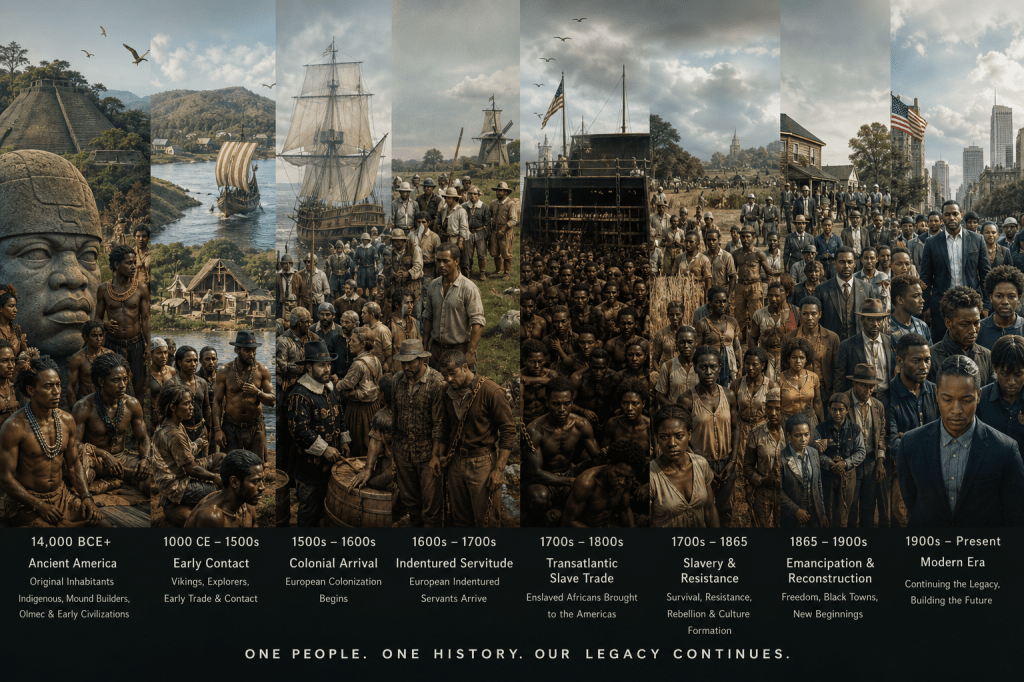
Visual Timeline
1. Before European Contact
Precolonial America
Before European contact, the Americas were home to diverse populations across North, Central, and South America. These societies developed complex cultures, trade systems, and land based communities long before the formation of the United States.
Black American historical understanding recognizes this period as part of a continuous American history before the development of modern national structures.
Visual idea: Map of the Americas, rivers, land, early communities.
2. Ancient Civilizations and Monumental Evidence
Olmec Heads and Early American Civilizations
Ancient American civilizations left behind monumental works that continue to be studied and interpreted today.
Among these are the Olmec colossal heads, large stone monuments found in present day Mexico. Within the Black American perspective, some view these features as resembling populations seen in parts of the modern Black American community.
This perspective is included as part of cultural interpretation and ongoing historical inquiry.
Visual idea: Olmec head, stone carving, ancient landscape.
3. Mound Builder Civilizations
Earthworks and Societal Development Across North America
Across North America, mound sites and earthworks reflect large scale organized societies with advanced knowledge of land use, construction, and ceremonial practices.
These mounds represent:
- Structured communities
- Engineering and planning
- Cultural and ceremonial life
- Long term settlement patterns
They stand as evidence of deep historical presence across the continent.
Visual idea: Aerial mound view, river valley, earth structures.
4. Early Contact and European Presence
Multiple Waves of Arrival
European presence in the Americas occurred through multiple waves over time.
These included:
- Early Norse exploration, often associated with Viking groups
- Later colonial expansion by various European powers
- Systems of labor migration, including indentured servitude involving Europeans from different regions
Indentured servitude included individuals from different parts of Europe and existed alongside other labor systems.
These overlapping populations contributed to the development of colonial societies and evolving systems of classification.
Visual idea: Old map, ships, layered historical imagery.
5. Forced Migration and Labor Systems
The Transatlantic Slave Trade and American Development
During colonial development, the Transatlantic Slave Trade and plantation labor systems shaped the lives of many people whose descendants would become part of the Black American lineage.
These systems played a central role in the economic and structural development of the United States.
Visual idea: Ledger books, fields, ships, symbolic chains.
6. Classification and Reclassification
Shifting Identity Labels Across Time
Across different historical periods, populations connected to Black Americans were recorded under changing classifications, including:
- Indian
- Negro
- Mulatto
- Creole
- Colored
- Black
- African American
These classifications were shaped by legal, social, and political systems and changed over time.
Visual idea: Census forms, documents, layered text.
7. Formation of the United States
War, Labor, and Nation Building
Black Americans were present during the formation and development of the United States.
Their contributions include:
- Labor systems and infrastructure
- Military service across multiple conflicts
- Community formation in rural and urban areas
- Cultural and social development
These contributions form part of the foundation of American society.
Visual idea: Flag, soldiers, workers, early towns.
8. Recognized Historical Communities
Freedmen, Black Seminoles, Buffalo Soldiers, and Others
Foundational Black American history includes multiple recognized communities and groups documented throughout American history, including:
- Freedmen communities
- Black Seminoles
- Buffalo Soldiers
- Creole and mixed heritage populations
These groups reflect resilience, adaptation, and continued presence.
Visual idea: Portrait collage, uniforms, family imagery.
9. The Meaning of “American”
Historical Definitions and Expansion
The meaning of the term “American” has changed over time.
Historical sources, including early editions of Webster’s Dictionary, defined “American” in reference to the Indigenous inhabitants of the Americas.
Over time, the definition expanded through legal and social developments to include all citizens of the United States.
Visual idea: Open dictionary, highlighted word, aged paper.
10. Present Day Continuity
A Living Lineage Based People
Today, Black Americans continue as a lineage based community shaped before, during, and after the development of America and the United States.
This continuity reflects:
- Historical presence
- Cultural development
- Shared experience across generations
This history supports ongoing efforts toward recognition, unity, and organized advancement.
Visual idea: Modern families, city skyline, community gathering.

